The 90-second build quiz
Golf simulator cost: what will your room cost to build?
Six questions about the ceiling, the space and the budget. The answer is the build that actually fits — with the clearance maths shown, the gear worth buying, and the complete cost breakdown for your situation.
Start the quizFree. We send your room-specific result and planner after the quiz.
How it works
- 1
Answer six questions
Which room it would go in, how high the ceiling is, how deep and how wide the space is, how tall the tallest golfer is, and what you are willing to spend. All taps, no typing. Not measured yet? There is an answer for that too.
- 2
Get a build, not a price range
Most people arrive here having read that a simulator costs anywhere between seven hundred dollars and seventy thousand. That is true and it is useless. The quiz puts you in one of five builds — putting room, practice bay, compact bay, full bay, premium room — and shows the arithmetic that put you there.
- 3
Get the breakdown for your situation
Then, if you want it, the numbers: your build costed line by line, the room-prep spending nobody quotes you, and the printable Golf Simulator Build Planner to measure with. Written for your result, not for everyone's.
Ready? It takes about ninety seconds.
Start the quizThe short answer
What does a golf simulator cost?
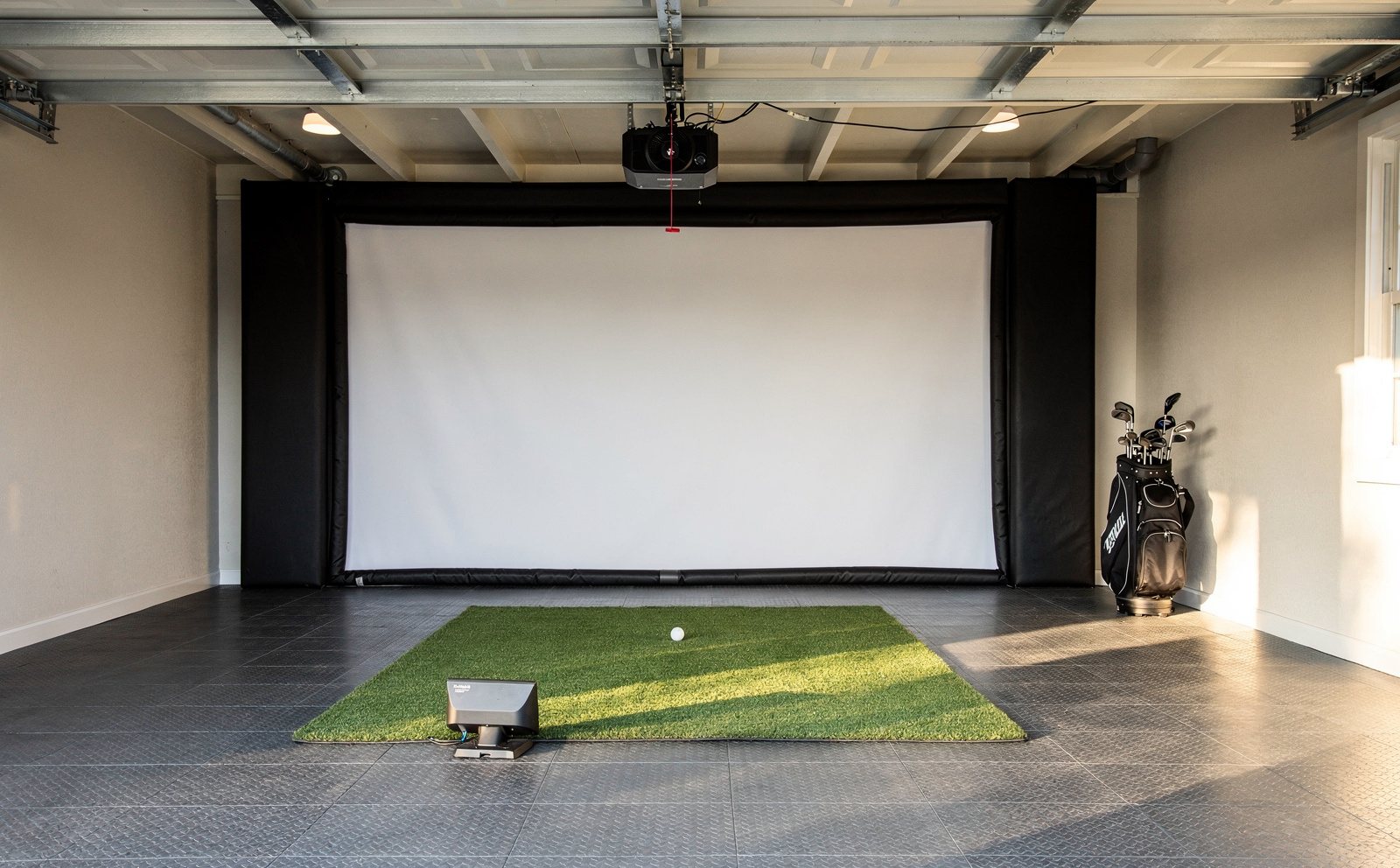
A golf simulator costs $700 to $1,500 for a net-and-mat practice setup, $3,000 to $8,000 for the screen-and-projector build most home golfers choose, and $8,000 to $25,000 for a finished premium room. Turnkey and commercial installations usually start around $25,000. In our 2026 cost index, the launch monitor is 18 to 46 percent of complete projector builds and current manufacturer bundles, while the ceiling, flooring, wiring and climate control decide how much the room adds.
| Build | Typical cost | What that budget buys |
|---|---|---|
| Net and mat | $700–$1,500 | A hitting net, a safe mat and an entry launch monitor, with results on a phone or tablet. |
| Entry screen build | $1,500–$3,000 | A basic enclosure or screen, a budget projector and entry-level measured ball data. |
| Complete home build | $3,000–$8,000 | A camera-based monitor, impact screen, enclosure, short-throw projector, mat and software. |
| Premium room | $8,000–$25,000 | Higher-grade tracking, a finished enclosure, better projection, flooring and some paid installation. |
| Turnkey or commercial | $25,000+ | A packaged room designed, supplied and installed as one project. |
The room changes the total
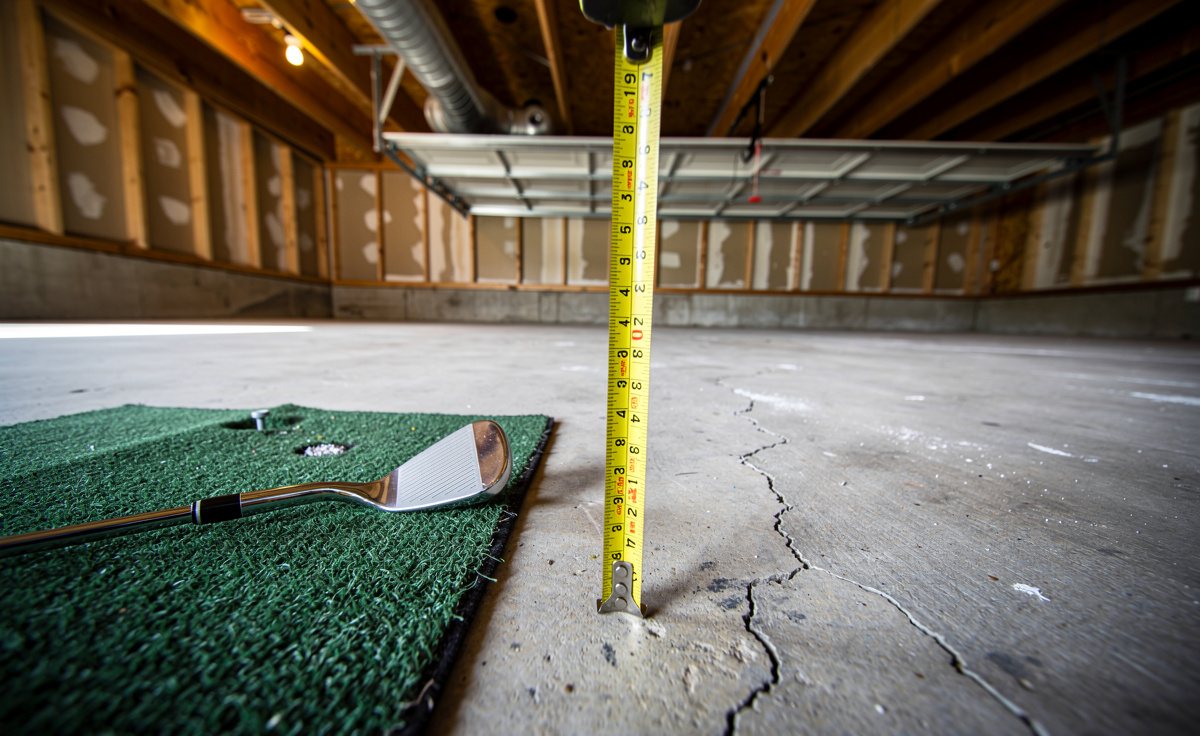
A garage is often the cheapest room because it already has enough width and an open floor. A realistic complete garage build is usually $3,000 to $5,000 before major electrical or heating work. Basements more often land at $5,000 to $10,000 because low joists, uneven floors and moisture control add work. A spare bedroom can support a $2,000 to $4,000 net or camera setup, but an eight-foot ceiling rules out a full driver swing for many golfers.
Measure the lowest obstruction, not the highest point in the room. Then check width and ball-flight depth. The 90-second build quiz applies those constraints, while the room-size guide explains the clearance math.
Where the equipment money goes
The launch monitor is the expensive part because it measures a fast-moving ball rather than simply stopping or displaying it. Entry units begin around $400 to $700. Camera-based models suited to shorter rooms commonly run from $1,000 to $2,500, while professional systems climb well beyond that. The remaining budget is split between the enclosure and screen, projector, hitting mat, computer, software and floor protection.
Do not save money by buying a monitor that needs more ball flight than the room provides. Spend on a mat that protects wrists and elbows, then match the screen and projector to the room. The component guide covers the parts, and the launch monitor guide separates camera and radar choices.
Golf simulator cost in year one and later years
First-year total = equipment + room work + delivery/tax where charged + installation + first-year software. A package may leave out some of these costs. Check each line before you compare a package with your own build. Room work may mean wiring, flooring, lights, sound treatment, heating or cooling, and work on the ceiling.
In later years, list the fees you pay again, such as software renewals and any monitor plan you need. Check the renewal terms for your chosen monitor and software. One yearly amount will not fit every build. Keep the parts you may choose to replace or upgrade, such as a mat, projector or computer, apart from those recurring fees.
For the full worksheet and line items, read the golf simulator budget breakdown. Use the build cost calculator for your room and budget. For dated sources, read the 2026 golf simulator cost data index.