Cost Research
Golf Simulator Cost Data: A Transparent 2026 Planning Index
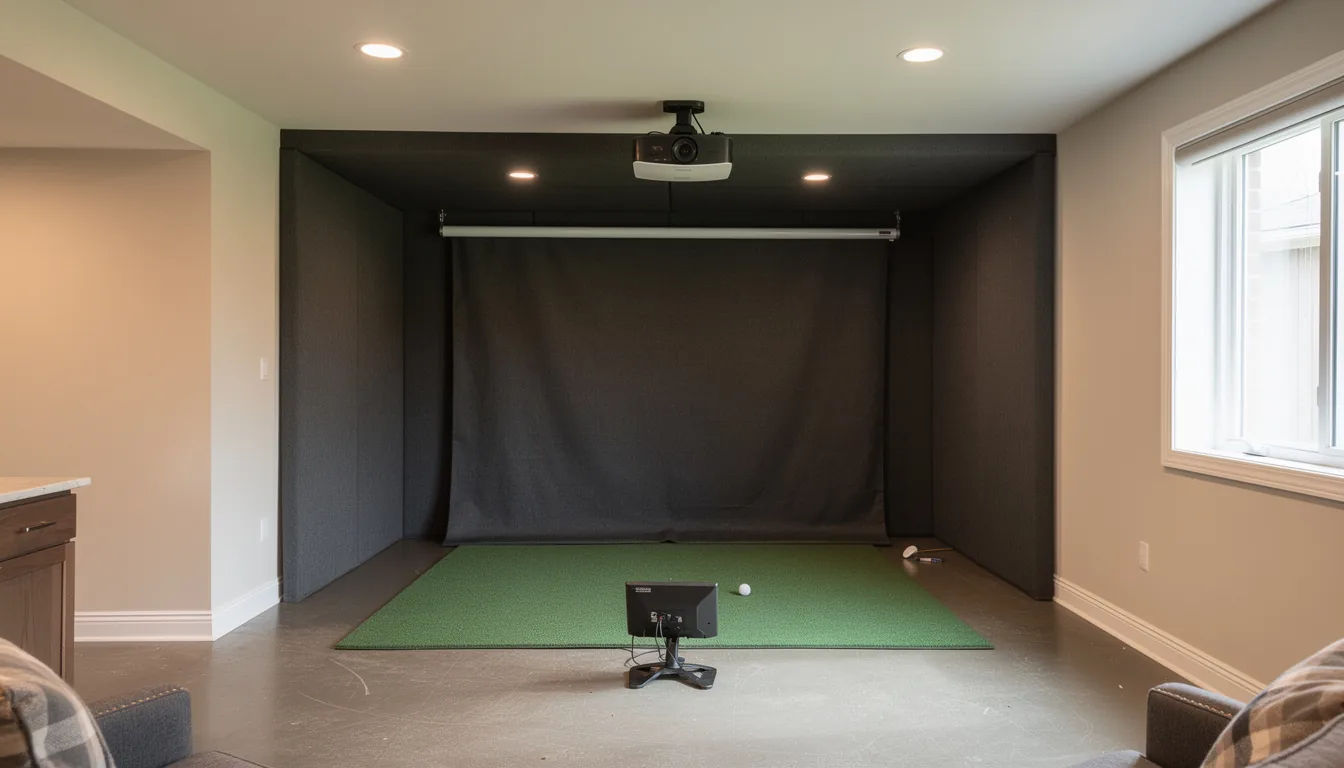
Our 2026 data supports a $700 to $1,500 practice setup and a $3,000 to $8,000 complete home build before major structural work. These are planning bands, not market averages. Across two itemized projector baskets and two manufacturer bundle comparisons, the launch monitor accounts for 18% to 46% of the total, so room and software choices must be priced separately.
This guide is part of Golf Simulator Budget Breakdown: Parts, Room Prep and Five-Year Costs.
Sections16
- What's new in the 2026 golf simulator cost data
- The 2026 planning index at a glance
- How to read observed, planning, and derived rows
- Current published price anchors
- Equipment ranges behind the planning bands
- Three reproducible build baskets
- What manufacturer bundles reveal
- Five-year total cost of ownership
- Sensitivity analysis: which assumptions move the total
- Room preparation stays outside the equipment subtotal
- Software price and compatibility rules
- How to use the data with the calculator and quiz
- Download, reuse, and cite the dataset
- Methodology and limitations
- Sources and provenance
- Verdict on the 2026 golf simulator cost data
Golf simulator cost data often mixes list prices, temporary sale prices, generic ranges, and guessed build totals. This 2026 planning index separates them. Every row is marked as observed, planning input, or derived, so a reader can see what came from a live source and what came from our arithmetic.
The central estimate is still useful: a basic net practice setup can fit a $700 to $1,500 planning band, while a complete home simulator often fits $3,000 to $8,000 before major structural work. Those bands are not market averages. They are bounded planning cases built from the line items documented below.
The short answer: the room around the launch monitor can cost as much as the tracking device, and software can add four figures over five years. Across two itemized projector baskets and two manufacturer bundle comparisons, the monitor represents 18% to 46% of the total. Download the full 2026 CSV or use the calculator to apply the assumptions to your room.
What's new in the 2026 golf simulator cost data
This edition replaces a loose range summary with a versioned ledger. It adds current manufacturer price anchors captured September 12, 2026, three exact site-research baskets, two manufacturer bundle comparisons, five-year ownership formulas, and a sensitivity table.
The update also corrects an overbroad shortcut. A launch monitor is not always 40% to 60% of a complete build. Its share is 18.0% in our premium itemized basket and 21.3% in our mid basket. It rises to 36.4% and 46.2% when current Bushnell launch-monitor prices are compared with the company's matching complete bundles. The mix, not one fixed percentage, controls the answer.
The 2026 planning index at a glance
| Planning case | First-year band | Five-year treatment | Data status |
|---|---|---|---|
| Net practice setup | $700 to $1,500 | Add software and consumables only if selected | Inferred compatible basket |
| Entry screen build | $1,000 to $3,000 | Add four renewal years after year one | Inferred compatible basket |
| Complete home build | $3,000 to $8,000 | Usually $3,800 to $11,000 using the $200 to $750 annual allowance | Inferred band plus formula |
| Premium room | $8,000 to $25,000 | Model software, mat wear, and upgrades separately | Inferred compatible basket |
| Turnkey or commercial | $25,000 and up | Quote-specific | Published package anchors plus planning floor |
The five-year complete-build range uses a simple formula: first-year build + (annual allowance x 4). The first year is already inside the build band, so adding five more years would count it twice. At the low end, $3,000 + ($200 x 4) = $3,800. At the high end, $8,000 + ($750 x 4) = $11,000.
That wide range is deliberate. A free app and a phone produce a different ownership cost from a launch-monitor platform plan stacked with third-party simulator software. Neither is wrong, but they are not the same purchase.
How to read observed, planning, and derived rows
The downloadable dataset uses three status labels.
Observed means a price or rule appeared on an accessible manufacturer page on the capture date. Examples include Rapsodo's MLM2PRO sale price, Bushnell's Launch Pro price, Trackman's starting price for Trackman iO, and GSPro's annual license. An observed price is still a snapshot. It can be a sale, can exclude tax and shipping, and can change after capture.
Planning input means a range was carried from the site's dated Golf Simulator Budget Breakdown. Those ranges compile equipment and room allowances into useful categories, such as $250 to $600 for an impact screen or $300 to $800 for ordinary electrical work. They are not one retailer's quote and are not called verified market minima or maxima.
Derived means the value was calculated from observed or planning rows. Every derived record names its formula. A derived build is a model, not evidence that a household paid that amount.
The distinction prevents a common data error. A precise total such as $6,098 can look more authoritative than a range, even when every component is a planning proxy. Precision shows that the addition is reproducible. It does not upgrade the source quality of the inputs.
Current published price anchors
These are the cleanest live anchors found in the September 12 source check. They cover tracking hardware, complete bundles, and software. They do not claim to cover every brand or every sale.
| Item | Published price | Price status | Source note |
|---|---|---|---|
| Rapsodo MLM2PRO | $599.99 | Sale price; $699.99 shown as prior price | Official Rapsodo product page |
| SKYTRAK ST+ | $1,995 | Sale price, but page says no longer available | Official SKYTRAK product page; excluded from current models |
| Bushnell Launch Pro Indoor | $1,999.99 | Current listed price | Official Bushnell collection page |
| Bushnell Launch Pro | $2,999.99 | Current listed price | Official Bushnell product page |
| Bushnell Launch Pro i bundle | $5,499.99 | Current complete indoor bundle | Official Bushnell collection page |
| Bushnell Launch Pro bundle | $6,499.99 | Current complete bundle | Official Bushnell collection page |
| Trackman iO | From $13,995 | Manufacturer starting price | Official Trackman product page |
| Bushnell Silver software | $199 per year | Current annual tier | Official Launch Pro product page |
| Bushnell Gold software | $499 per year | Current annual tier | Official Launch Pro product page |
| GSPro Version 3 | $250 per year | Current annual license | Official GSPro site |
The Garmin Approach R10 page was also checked, but its accessible text did not expose a current U.S. price. The index therefore does not fill one from memory. A missing accessible price stays unpublished_in_capture in the CSV.
The SKYTRAK ST+ illustrates another reason for status fields. Its official page still showed a $1,995 sale price, then stated that the unit was no longer available. A scraper that records only the number would publish a false shopping option. This index keeps the price for historical context but excludes the item from live basket math.
Equipment ranges behind the planning bands
The broad component ranges come from the site's budget breakdown and components guide. They are useful for early planning because a product-specific dataset cannot represent every DIY frame, existing computer, or local contractor quote.
| Component | Planning range | Main reason for spread |
|---|---|---|
| Entry launch monitor | $400 to $700 | Radar or phone-assisted tracking, sales, included software |
| Mid camera-based monitor | $1,000 to $2,500 | Camera system, club data, indoor space fit |
| Impact screen | $250 to $600 | Fabric layers, finish, size |
| Net | $150 to $300 | Size, frame, side protection |
| Enclosure or frame | $80 to $4,000 | Raw DIY materials through pre-built cabinet |
| Hitting mat | $50 to $950 | Strip versus full stance mat, depth, replaceable insert |
| Projector | $400 to $4,000 | Resolution, brightness, laser, throw ratio |
| PC or tablet | $0 to $2,800 | Existing device through a new high-end PC |
| Turf and floor padding | $200 to $1,200 | Area, subfloor, foam, finish |
| First-year software | $0 to $600 | Included app through paid platform and course play |
Adding every upper limit would produce a false basket. A $4,000 enclosure, $4,000 projector, $2,800 PC, and $950 mat belong to a high-finish room. They do not describe the upper edge of an entry build.
The index instead groups compatible choices. The $700 to $1,500 practice band uses a net, mat, entry monitor, and a display already owned. The $3,000 to $8,000 complete band adds a screen, enclosure, projector, suitable computer, and first-year software. Structural work and paid installation remain separate because not every room needs them.
Three reproducible build baskets
These reference baskets use the exact proxy inputs already documented in the site's budget research. They are not product recommendations. Their purpose is to make the arithmetic inspectable.
Spare-room net basket: $2,399
| Line item | Model input |
|---|---|
| Camera-based launch monitor | $1,499 |
| Net and frame | $300 |
| Mid-range mat | $250 |
| Existing tablet | $0 |
| First-year software | $150 |
| Sound treatment | $200 |
| Exact first-year total | $2,399 |
Formula: 1499 + 300 + 250 + 0 + 150 + 200 = 2399.
This model spends 62.5% on the launch monitor because it skips projection, a new PC, and a full enclosure. It is the clearest example of why a monitor-share rule cannot be applied across all room types.
Mid projector basket: $6,098
| Line item | Model input | Share of total |
|---|---|---|
| Launch monitor | $1,299 | 21.3% |
| Enclosure and screen | $1,350 | 22.1% |
| Short-throw projector | $849 | 13.9% |
| Hitting mat | $250 | 4.1% |
| Gaming PC | $1,100 | 18.0% |
| First-year software | $250 | 4.1% |
| Electrical and lighting | $500 | 8.2% |
| Turf | $300 | 4.9% |
| Accessories | $200 | 3.3% |
| Exact first-year total | $6,098 | 100% |
Formula: 1299 + 1350 + 849 + 250 + 1100 + 250 + 500 + 300 + 200 = 6098.
The enclosure is slightly more expensive than the launch monitor in this model. The PC plus projector account for another 31.9%. A shopper who budgets only for tracking hardware would miss most of the room.
Premium projector basket: $13,845
| Line item | Model input | Share of total |
|---|---|---|
| Launch monitor | $2,499 | 18.0% |
| Pre-built enclosure | $3,599 | 26.0% |
| 4K short-throw projector | $1,399 | 10.1% |
| Studio mat | $949 | 6.9% |
| High-end PC | $1,900 | 13.7% |
| First-year platform plan | $499 | 3.6% |
| Room preparation | $800 | 5.8% |
| Turf and padding | $900 | 6.5% |
| Mounting and wiring | $1,000 | 7.2% |
| Accessories | $300 | 2.2% |
| Exact first-year total | $13,845 | 100% |
Formula: 2499 + 3599 + 1399 + 949 + 1900 + 499 + 800 + 900 + 1000 + 300 = 13845.
The enclosure is the largest line. The launch monitor is less than one fifth of the modeled total. This does not prove that every premium room follows the same split. It proves that premium finish choices can reverse the usual hardware-first assumption.
What manufacturer bundles reveal
Bushnell provides two useful same-publisher comparisons. The company listed Launch Pro Indoor at $1,999.99 and its matching simulator bundle at $5,499.99. It listed Launch Pro at $2,999.99 and the matching simulator bundle at $6,499.99.
The hardware shares are reproducible:
1999.99 / 5499.99 = 36.36%for the indoor bundle.2999.99 / 6499.99 = 46.15%for the indoor-and-outdoor bundle.
These comparisons are cleaner than mixing prices from several sellers because the hardware and bundle were captured from one manufacturer at one time. They still have limits. Bundle contents can change, and the listed package may exclude room construction, tax, installation, or a long-term software plan.
Taken together, the two itemized projector baskets and two manufacturer bundle comparisons produce a variable 18% to 46% hardware share, not a fixed 40% to 60% rule. The spare-room net basket reaches 62.5% only because it excludes the costly screen, projector, enclosure, and PC.
Five-year total cost of ownership
First-year cost and five-year cost answer different questions. This index uses the following formula when first-year software is already included:
five-year cost = first-year total + (annual renewal and consumables x 4)
| Scenario | First-year total | Annual allowance after year one | Five-year total |
|---|---|---|---|
| Mid basket, low running cost | $6,098 | $200 | $6,898 |
| Mid basket, model allowance | $6,098 | $350 | $7,498 |
| Mid basket, high running cost | $6,098 | $750 | $9,098 |
| Premium basket, stacked model | $13,845 | $900 | $17,445 |
The $900 premium allowance sits above the general $200 to $750 band because it represents stacked software and consumables rather than one ordinary subscription. It is a scenario input, not a market average.
Product ecosystems can be modeled with observed prices too. Bushnell lists Launch Pro Gold software at $499 per year. GSPro lists its annual license at $250, and both companies state that a Launch Pro user needs Gold before using GSPro. The combined recurring price is therefore $499 + $250 = $749 per year, before tax.
Across five paid years, that stack is $749 x 5 = $3,745. Add the current $2,999.99 Launch Pro hardware price and the monitor-plus-software subtotal becomes $6,744.99 before adding a mat, screen, enclosure, projector, PC, floor, or room work.
That example is not a recommended package. It shows why software compatibility and prerequisites belong in the cost dataset. A $250 simulator license can carry a second required platform charge.
Sensitivity analysis: which assumptions move the total
The $6,098 mid basket is a useful baseline because every major component is visible. Changing one assumption at a time shows which choices matter.
| Change to the mid basket | New first-year total | Change from baseline |
|---|---|---|
| Reuse an existing gaming PC | $4,998 | -18.0% |
| Spend $500 more on projector | $6,598 | +8.2% |
| Spend $1,000 more on launch monitor | $7,098 | +16.4% |
| Add $1,000 of room work | $7,098 | +16.4% |
| Add paid installation at $1,500 | $7,598 | +24.6% |
| Add $250 to annual running cost | No first-year change | +$1,000 over years two through five |
The table gives two practical findings. First, an existing computer saves more than moving a projector up by $500 costs. Second, room work can move the total as much as a major launch-monitor upgrade.
Annual cost is less visible at checkout but compounds. Raising the annual allowance by $250 adds $250 x 4 = $1,000 after the first year. That is the same five-year effect as adding $1,000 of room work on day one, even though the charges arrive at different times.
Sensitivity is more useful than pretending there is one perfect total. A buyer can replace each proxy with a quote and immediately see the effect without rebuilding the whole model.
Room preparation stays outside the equipment subtotal
The site's room research records ordinary electrical work at $300 to $800, possible panel work at $800 to $2,000, ceiling finishing at $1,000 to $3,000, sound treatment at $200 to $600, heating or cooling at $50 to $2,000, and paid installation at $1,500 to $5,000.
These ranges should not all be added to every build. A finished bonus room may need no panel work or ceiling finish. An unfinished garage may need climate control, insulation, lighting, and a door-opener change. A basement can be cheap until ceiling clearance requires structural work.
For an otherwise usable room, this index keeps a $0 to $2,000 general room-prep allowance. It is a planning row, not an observed quote. Ceiling reconstruction, a service-panel upgrade, climate installation, and paid simulator installation stay as separate exceptions.
Room fit can also invalidate a budget. A radar monitor may need more distance behind and in front of the ball than a camera unit. Flooring and mat thickness reduce true ceiling clearance. Use the room-size guide and ceiling-height method before treating any basket as viable.
The budget cannot solve a physical mismatch. A shorter room may force a camera-based monitor even when an entry radar unit costs less. That is a constraint change, not an upgrade made for prestige.
Software price and compatibility rules
GSPro's official site listed Version 3 at $250 per year on the capture date. It also listed Windows 10 or 11 as the required operating system and gave different graphics guidance for 1080p and 4K play. That means the software choice can affect both the annual fee and the PC line.
The same source lists supported launch monitors and notes extra prerequisites for some ecosystems. Bushnell Launch Pro requires an active Gold subscription for GSPro access. Uneekor requires its active Pro package. Rapsodo MLM2PRO requires a Rapsodo Premium membership. A shopper cannot assume that paying GSPro alone unlocks every compatible unit.
Rapsodo's official MLM2PRO page showed a 45-day Premium trial and automatic billing after the trial unless canceled. Its accessible product text did not expose the annual renewal amount during this capture. The CSV records that annual price as unknown instead of filling it from a reseller or an older article.
Unknown is a useful result. It tells the buyer which cost must be confirmed in the account flow before purchase. It also prevents a stale subscription price from looking current merely because the hardware page remained accessible.
How to use the data with the calculator and quiz
The data page explains the assumptions. The build cost calculator applies them to a room and budget. The 90-second quiz helps choose a setup type when the room or use case is still unclear.
Use the tools in this order:
- Measure room width, front-to-back length, and clear height at the planned hitting area.
- Use the quiz if those measurements do not yet point to a tracking type.
- Use the calculator to build a first equipment and room allowance.
- Replace model inputs with current product prices and local quotes.
- Add four renewal years for a five-year view.
- Check every software prerequisite before buying the launch monitor.
The components guide is the fit check after the estimate. It explains how the monitor position controls the mat, how screen width controls projector throw, and how floor depth changes ceiling clearance.
Download, reuse, and cite the dataset
The golf simulator cost data CSV includes published anchors, planning ranges, exact basket totals, bundle ratios, and five-year outputs. Each row carries a status, unit, source, capture date, formula or context note, and limitation.
You may reuse the file with attribution. Keep each row's status and source fields. Do not relabel a planning input as a verified retail price or a derived basket as an observed household spend.
Suggested citation:
Golf Simulator Cost, "Golf Simulator Cost Data: A Transparent 2026 Planning Index," updated September 12, 2026, https://golfsimulatorcost.com/cost/2026-cost-index/.
For a chart or newsroom table, cite the original manufacturer for a product price and this page for the compilation or calculation. Re-check the live source if the current price, rather than the September 12 snapshot, matters to the story.
Methodology and limitations
The source pass was completed September 12, 2026. The method used five rules:
- Capture accessible U.S. manufacturer pages before retailer or editorial summaries.
- Record sale, list, starting, unavailable, and unpublished states instead of storing a bare number.
- Keep broad component research labeled as planning input.
- Publish formulas for every subtotal, share, and five-year result.
- Exclude tax, shipping, financing cost, resale value, and opportunity cost unless a scenario names them.
No private sales ledger, homeowner survey, affiliate dashboard, or manufacturer wholesale feed was used. The index cannot support claims about average household spending, median build price, product reliability, or resale value.
Prices can move daily. Local labor and electrical quotes vary by location and job scope. Product pages can retain a price after a unit becomes unavailable, as the SKYTRAK ST+ capture showed. Starting prices can omit options. Bundle contents can change without the component name changing.
The exact basket totals are arithmetic models. Their precision does not mean that every buyer can purchase each line at the same amount. Their value is reproducibility: replace one input, repeat the sum, and the effect is visible.
Sources and provenance
- Rapsodo MLM2PRO, accessed September 12, 2026. Source for the $599.99 sale price, $699.99 prior price, 45-day Premium trial, and annual-price gap in accessible text.
- SKYTRAK ST+, accessed September 12, 2026. Source for the retained $1,995 sale display and no-longer-available status.
- Bushnell Launch Pro, accessed September 12, 2026. Source for $2,999.99 hardware, $199 Silver, $499 Gold, and the Gold prerequisite for separate GSPro access.
- Bushnell launch monitors, accessed September 12, 2026. Source for the $1,999.99 Launch Pro Indoor anchor.
- Bushnell simulator bundles, accessed September 12, 2026. Source for the $5,499.99 and $6,499.99 complete-bundle anchors.
- GSPro Version 3, accessed September 12, 2026. Source for the $250 annual price, system requirements, supported units, and ecosystem prerequisites.
- Trackman iO, accessed September 12, 2026. Source for the $13,995 starting price.
- Garmin Approach R10, accessed September 12, 2026. Checked as an official source, but no accessible current U.S. price was captured.
- Golf Simulator Budget Breakdown, updated August 29, 2026. Site source for component and room-preparation planning ranges.
- Golf Simulator Components, updated August 26, 2026. Site source for fit dependencies and replacement-cost context.
Verdict on the 2026 golf simulator cost data
Use $700 to $1,500 for a net practice plan and $3,000 to $8,000 for a complete home simulator before major room work. Treat both as planning bands, not averages.
The stronger finding is about budget shape. Across two itemized projector baskets and two manufacturer bundle comparisons, the launch monitor ranges from 18% to 46% of the total. Software can add $1,250 for five years of GSPro alone, or $3,745 when Bushnell Gold and GSPro are stacked for five paid years at the captured rates.
Measure first, price the full compatible basket second, and calculate renewals last. The calculator handles the numbers, while the space guide decides whether the basket can work in the room at all.
Quick answers
Is this a survey of what homeowners actually paid?
No. It is a planning index, not a household survey or sales ledger. Observed rows reproduce published manufacturer prices. Planning rows come from the site's dated component research. Derived rows show exact formulas. The dataset never presents its build bands as a measured average or median.
How much does a complete home golf simulator cost in 2026?
Use $3,000 to $8,000 as a first planning band for a complete home build with a launch monitor, enclosure, screen, projector, mat, display, and first-year software. Major ceiling work, climate control, premium tracking, or paid installation can move the total above that band.
Is the launch monitor always most of the budget?
No. It accounts for 18% to 21% in this index's two itemized site-research baskets. In two current Bushnell hardware-versus-bundle comparisons, it accounts for about 36% and 46%. The share changes with the monitor tier and the amount of room gear bundled around it.
How much can software add over five years?
GSPro alone is $250 per year, or $1,250 over five years at the captured price. Bushnell lists Silver at $199 and Gold at $499 per year, and requires Gold before a Launch Pro can use GSPro. That stacked path totals $749 per year before taxes.
Can I download and cite the golf simulator cost data?
Yes. The CSV is free to download and cite with attribution. Keep the status, source URL, capture date, and notes with each row. Prices can change, and model rows are not observed transactions. For a current purchase, re-check the linked manufacturer page before ordering.