Putting Greens
Putting Green Cost: What a Backyard or Indoor Green Really Runs
As an Amazon Associate, this website earns from qualifying purchases.
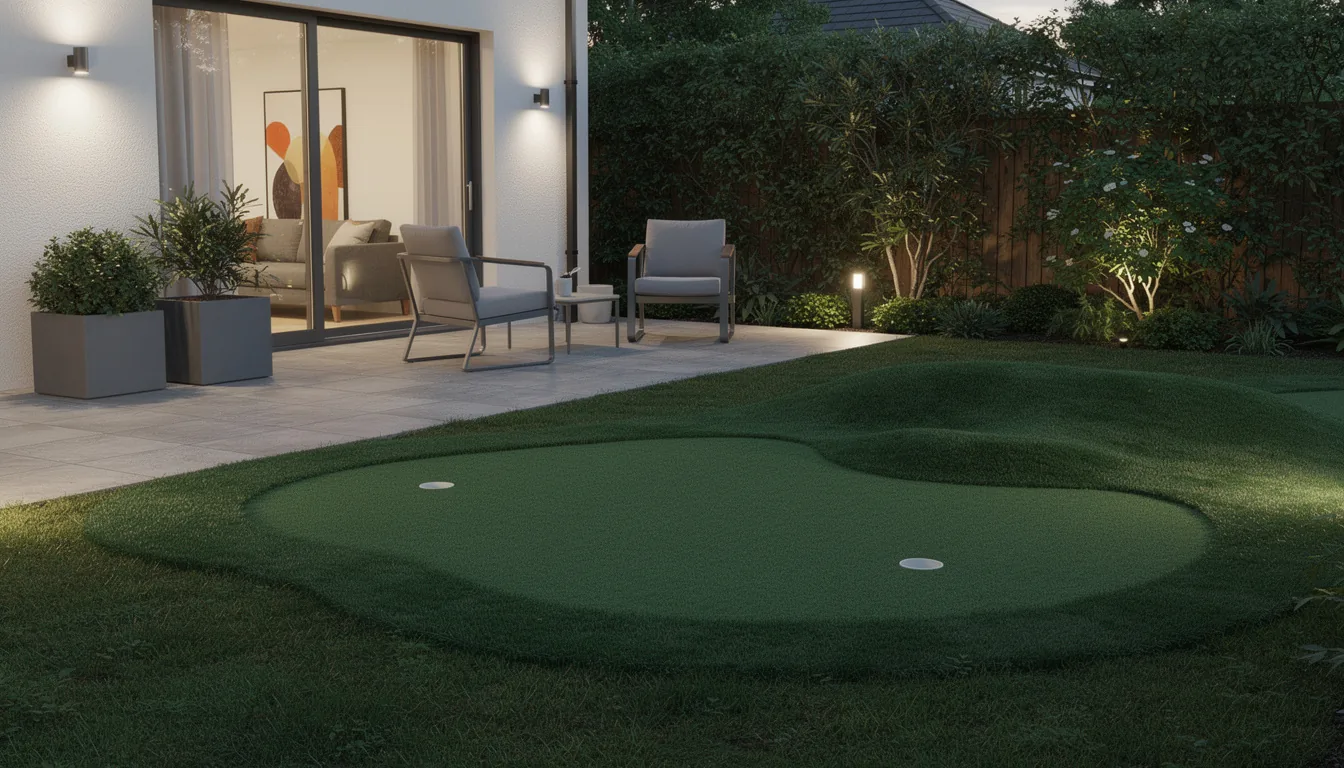
A putting green costs $6 to $12 per square foot in DIY materials and $15 to $40 per square foot installed, so most homeowners land between $3,500 and $9,000 outdoors, with real-grass greens costing about $18 to $25 per square foot to build and $1,500 to $4,000 a year to keep. Indoors, a roll-out mat starts at $50.
Sections13
- Choose Indoor or Outdoor Before You Price It
- Backyard Putting Green Cost per Square Foot
- What Size Green Actually Makes Sense
- Where the Money Goes on an Installed Green
- A Simple Quote Checklist Before You Sign
- Match the Green to the Practice You Will Actually Do
- Site Prep and Drainage: The Line Nobody Quotes
- Edging, Cups and the Extras
- Real Grass vs Synthetic: The Ten-Year Number
- When DIY Actually Saves Money
- What It Costs to Keep
- Three Example Backyard Putting Green Budgets
- The Verdict on Putting Green Cost
A backyard putting green costs $6 to $12 per square foot if you lay it yourself and $15 to $40 per square foot installed by a crew. That spread is not vague pricing. It is the difference between renting a plate compactor for a weekend and paying someone $6 to $10 per square foot in labour on top of materials.
Choose Indoor or Outdoor Before You Price It
This guide's headline figures are for an outdoor green: excavation, aggregate base, drainage, edging and installation. If the email or search question is about putting in a basement, spare room or hallway, do not apply those excavation figures. Start with the indoor putting green guide and compare indoor putting surfaces at Indoor Golf Shop. A roll-out surface is the relevant first purchase for a low-ceiling room; a permanent outdoor build is not.
For a finished project, Angi puts the normal range at $3,500 to $9,000 with an average near $4,300, across a full span of $2,500 to $75,000. Most people reading this will land in the $4,000 to $12,000 band. The three numbers that move you inside it are size, what is under the turf, and whether you or somebody else does the digging.
Backyard Putting Green Cost per Square Foot
Per-square-foot pricing is how installers quote, so it is how you should compare. Bigger greens cost less per foot because fixed costs spread further.
- Under 400 square feet: $25 to $40 per square foot. Mobilisation, base prep and cups cost nearly the same on a small green as a large one. Southwest Greens lists $30 to $35 per square foot under 400 feet.
- 400 to 2,000 square feet: $20 to $30 per square foot. The band most yards fall into, and the best price per foot for a usable green.
- Over 2,000 square feet: $15 to $25 per square foot. Efficient per foot, but the total is large and so is the yard it eats.
DIY works out very differently. Materials alone run $6 to $12 per square foot, and pre-cut kits sell for $5 to $13 per square foot. Turf is the biggest slice: putting-specific turf runs $4 to $8 per square foot on its own, and premium grades reach $10 to $25.
The honest way to read these numbers is total, not rate. A 200 square foot DIY green runs about $1,280 to $2,725 in materials. The same green installed runs $5,000 to $9,000. If you want to sanity-check a quote against a full home golf budget, the cost calculator covers the wider build.
What Size Green Actually Makes Sense
Choose the space for the practice you want. These size bands are example layouts, not a size every yard needs.
| Example layout | Intended practice | What to measure before choosing it |
|---|---|---|
| 150–300 square feet | Short putts with one or two cup positions | Available length and width, plus space to stand at each end |
| 300–500 square feet | Breaking putts and chips from a fringe | Putt lengths, fringe width and clear space for the chips you plan to practise |
| 800–1,200 square feet | Longer putts and shots from several angles | Each shot path, the space around the green and access for the build |
| 1,500–3,000 square feet | A large layout with fringe and shaped slopes | The full footprint, nearby boundaries and how much yard remains for other uses |
For rates by size, use the per-square-foot section and Angi's size and rate guide, updated 9 July 2026. Then use the existing quote checklist to check what the installer includes. Area alone does not give you an installed total.
Golfers who want year-round practice can compare a modest outdoor green with an indoor putting green somewhere that works in January. For that indoor intent, compare indoor putting surfaces at Indoor Golf Shop before pricing outdoor excavation. Putting needs no headroom, so even a room that fails the ceiling height test will take one.
Where the Money Goes on an Installed Green
A quote is four things stacked. Knowing the split tells you which line an installer is padding.
- Turf: $4 to $8 per square foot for putting-specific grades, more for premium. Pile height and fibre type set roll speed.
- Base materials: $2 to $4 per square foot. Crushed stone or decomposed granite at $1 to $2, compaction and levelling on top.
- Labour: $6 to $10 per square foot. Excavation, grading, compaction, seaming, infill, cups. This is the line DIY removes.
- Total base cost lands at $3 to $6 per square foot once excavation, stone, compaction and weed barrier are counted.
Angi's own breakdown of a 250 square foot green shows $1,250 to $5,000 in materials, $750 to $2,250 in installation labour and $50 to $200 for excavation, for a total of $2,050 to $7,450, or $8 to $30 per square foot all in. You can read the full Angi cost breakdown if you want the line items in their own words.
A Simple Quote Checklist Before You Sign
Ask an installer to separate the quote into excavation, base, drainage, turf, edging, cups and labour. A single square-foot number hides the lines that vary most between yards. Confirm whether the price includes removing the existing lawn, hauling spoil, compacting each base lift and taking away leftover material.
Also ask where the finished surface will sit relative to the surrounding lawn. A green that drains toward a house, fence or neighbour will need a different plan from one on a naturally open part of the yard. If the quote does not describe the fall and the drainage route, it is not yet a complete plan. The flooring guide applies the same finished-height principle indoors, where the subfloor changes the room before the visible surface goes down.
For a DIY build, price the base and tool rental before buying turf. The turf is the visible line, but compaction, excavation, waste and edging decide whether the material estimate resembles the final spend. Use the DIY simulator cost guide for the broader trade-off between doing the work yourself and paying for labour.
Match the Green to the Practice You Will Actually Do
Choose the smallest layout that supports the shots you intend to practise. A compact green with one or two cups is enough for start lines and short putts. A 300 to 500 square foot layout earns its larger footprint when you will use the fringe, practise breaking putts or share the space with family. A much larger green buys more angles and shaping, not automatically better practice.
If the main goal is year-round repetition rather than outdoor landscaping, compare the outdoor quote with an indoor putting green. If you also want to practise full swings, keep the putting budget separate and check the room guide and component guide before treating one surface as a complete simulator build.
Site Prep and Drainage: The Line Nobody Quotes
This is where honest quotes and cheap quotes separate, and where failed greens come from.
Every synthetic green sits on a compacted aggregate base. Skip it, or under-compact it, and the surface develops low spots inside two seasons. Excavation and debris removal runs $0.50 to $1 per square foot on a normal lot. Land excavation on a difficult one runs $50 to $200 per cubic yard.
Drainage is the add-on worth paying for. A drainage pipe system runs $300 to $900. On clay-heavy or low-lying lots, perforated drain lines run $500 to $2,000 and prevent the kind of failure that costs a full rebuild. Texas Tuff makes the point plainly: that spend prevents expensive failures later.
Two site conditions can double a quote on their own:
- Bad access. No gate wide enough for a machine means everything moves by wheelbarrow, and labour hours climb.
- Slope. A yard that needs real grading pulls in retaining work before a single roll of turf arrives.
Get the base right and the green lasts. Get it wrong and you have paid $20 per square foot for a puddle. The same logic applies indoors, where flooring and sub-base choices decide whether a build feels solid.
Edging, Cups and the Extras
The extras are where a $6,000 project quietly becomes $11,000. Texas Tuff puts a typical mid-size add-on budget at $2,000 to $12,000.
- Cups and flagsticks: $50 to $200 per hole. Angi budgets about $150 per flagstick and hole at install, and about $150 to add or move a hole later.
- Edging or border: $500 to $2,000 for timber or simple stone. A full retaining wall runs $1,000 to $5,000.
- Undulations and contouring: add $3 to $8 per square foot. Shaped into the base before turf goes down, so it cannot be added cheaply afterwards.
- Fringe turf: add $2 to $5 per square foot. A different pile height around the edge, which is what makes chipping feel real.
- Lighting: $500 to $3,000 for low-voltage LED borders. Full outdoor lighting runs $2,000 to $4,500.
- Sand bunker: $800 to $2,500 with a proper liner.
Undulations are the one to decide early. They are cheap as base shaping and impossible to retrofit. Everything else on this list can wait a year.
One extra worth budgeting separately: a chipping net at the far end turns a putting green into a short-game area for very little money. The net guide covers which ones survive being left outdoors.
Real Grass vs Synthetic: The Ten-Year Number
Building a real-grass green costs about what synthetic costs. Keeping one is where the two part company.
The USGA's Green Section Record puts a properly constructed bentgrass green at $18 to $20 per square foot with a reputable contractor, around $25 per square foot once you count the surround, and over $30 for premium materials and custom work. So far, comparable.
Then the upkeep starts. Synthetic runs under $200 a year. A well-maintained natural green runs $1,500 to $4,000 a year. A greens mower alone starts upward of $10,000, and the USGA is direct that maintaining a backyard green properly is close to a full-time job: mowing at putting height, rolling, topdressing, aeration, disease watch.
Over ten years on a 500 square foot green, the operating gap compounds to $12,000 to $20,000 in favour of synthetic. Total ten-year spend typically differs by $10,000 to $18,000.
Real grass makes sense in one case: you genuinely enjoy greenkeeping as a hobby in itself. Otherwise synthetic wins on every line.
When DIY Actually Saves Money
DIY removes the $6 to $10 per square foot labour line. On a 300 square foot green that is $1,800 to $3,000 back in your pocket. Whether you keep it depends on the ground.
DIY makes sense when:
- The area is flat or close to it, so grading is minor.
- The green is under about 400 square feet, which is one honest weekend for two people.
- Drainage is not a problem already, meaning water leaves that part of the yard on its own.
- You will rent the right tools. A plate compactor runs about $100 a day, and total tool rental runs $150 to $300.
Pay a crew when:
- The yard slopes, holds water, or sits on heavy clay.
- You want real undulations. Shaping a base to roll true is a craft skill.
- Access is tight and material has to be moved by hand.
- The green is over 800 square feet, where mistakes get expensive fast.
Budget $280 to $500 for tools if you own none. That is still far below the labour it replaces. Anyone comfortable with this kind of work will recognise the same trade-off in the DIY simulator build costs, where doing it yourself moves similar money.
What It Costs to Keep
Synthetic upkeep is close to nothing, but it is not zero.
- Brushing: $0 to $150 a year if you do it yourself, monthly with a stiff brush to stand the fibres up.
- Leaf blowing: $0 to $80 a year.
- Infill top-up: $50 to $150 a year, optional, and only on greens that see heavy play.
- Seam repair every 3 to 5 years: $100 to $250.
- Patching, if needed: $2 to $8 per square foot.
Call it under $200 a year all in, which matches what installers quote. Set against green fees, the maths is quick: the National Golf Foundation's average green fee data used in Texas Tuff's modelling runs $75 to $150 a round, so a golfer paying $150 to $300 a month in fees recovers a mid-range green over a handful of seasons.
Three Example Backyard Putting Green Budgets
These are illustrative budget calculations, not three paid projects or customer receipts. Use dated supplier prices and a local quote for the amounts. No assumed dollar rates or totals are shown here.
The weekend green. 200 square feet, DIY, flat lawn, two cups, no undulation. Materials and rental total = turf + base materials + infill sand + cups and flags + seam tape + tool rental. For turf sold by area, multiply its quoted rate per square foot by 200; use the supplier's required quantities for the other materials. This budget excludes paid installation.
The family green. 400 square feet, installed, mild grading, three cups, fringe, simple timber edging. Total = 400 × the quoted installed rate per square foot + edging if excluded from that quote. Check that the rate includes the grading, cups and fringe before adding any of them again.
The showpiece. 1,000 square feet, installed, real contouring, bunker, lighting. Total = 1,000 × the quoted installed rate per square foot + shaping + bunker + lighting, adding only extras excluded from the quoted rate. Ask the installer to state those inclusions so the same work is not counted twice.
The 400-square-foot example is twice the area of the 200-square-foot example. The first excludes paid installation, so the totals are not a like-for-like price comparison.
Worth saying plainly: a green only fixes putting. If your strokes are going somewhere between the tee and the green, the same money spent on a sensor and a net does more, and the launch monitor guide covers how to pick one for the room you have.
Putting green turf and cup kits cut to your dimensions
The Verdict on Putting Green Cost
Putting green cost comes down to one decision: who does the digging. DIY materials run $6 to $12 per square foot. An installed green runs $15 to $40, with most mid-size projects at $20 to $30. Angi's normal range of $3,500 to $9,000 is where most finished projects land, and 300 to 500 square feet at $4,500 to $8,500 is the size that gives the most practice per pound spent.
Spend on the base and the drainage. Those two lines decide whether the green is still true in five years, and neither can be fixed cheaply afterwards. Undulations too, since they are shaped into the base or not at all. Lighting, bunkers and extra cups can all wait.
Skip real grass unless greenkeeping is the hobby. The build costs the same, and then it asks for $1,500 to $4,000 a year and a $10,000 mower forever. The USGA does not sugar-coat that one either.
If the yard will not take a green, the money is not wasted. Put it indoors instead, where an indoor putting green or a full simulator build gives you practice in every month of the year. The free Golf Simulator Build Planner has the measuring worksheet and budget tiers for both, and the space guide will tell you what your house can hold.
Where to go next: indoor putting greens for the version that fits a hallway, the full simulator cost breakdown if the green is one line in a bigger project, room size and clearance before you commit any square footage, the component guide for what a full bay needs, and the launch monitor guide if the long game is the part actually costing you strokes.
A specialty retailer stocking practice greens and putting surfaces
Quick answers
How much does a putting green cost to install?
Installed synthetic greens run $15 to $40 per square foot, so a typical finished backyard project lands between $3,500 and $9,000. Installation labour alone is $6 to $10 per square foot of that, which is why doing the base yourself is the single biggest saving available.
How much does a backyard putting green cost?
Installed synthetic greens run $15 to $40 per square foot, and Angi puts the normal range for a finished project at $3,500 to $9,000 with an average near $4,300. DIY materials cut that to $6 to $12 per square foot. Real grass costs about $18 to $25 per square foot to build.
What is the cheapest way to get a backyard putting green?
A roll-out mat at $50 to $250 works the same night and needs no groundwork. After that, a DIY synthetic build with putting-specific turf and a compacted stone base runs $6 to $12 per square foot in materials, so a 200 square foot green lands near $1,280 to $2,725.
What size backyard putting green should I build?
Between 300 and 500 square feet is the sweet spot for most yards. It holds three or four cups and real chip shots, and installed cost runs about $4,500 to $8,500. Below 150 square feet the per-foot price climbs because fixed costs spread over less ground.
Is a real grass putting green worth it at home?
Rarely. Building one costs about $18 to $25 per square foot, similar to synthetic, but upkeep runs $1,500 to $4,000 a year against under $200 for synthetic. A greens mower alone starts around $10,000. The USGA is blunt that maintaining one is close to a full-time job.
Does a backyard putting green add value to a home?
It is a taste-specific feature, so treat it as something you build for yourself rather than for resale. A well-drained synthetic green in good condition reads as finished landscaping. An oversized or failing green can read as a problem the next owner has to remove.