Putting Greens
Indoor Putting Green: How to Pick One That Rolls True
As an Amazon Associate, this website earns from qualifying purchases.
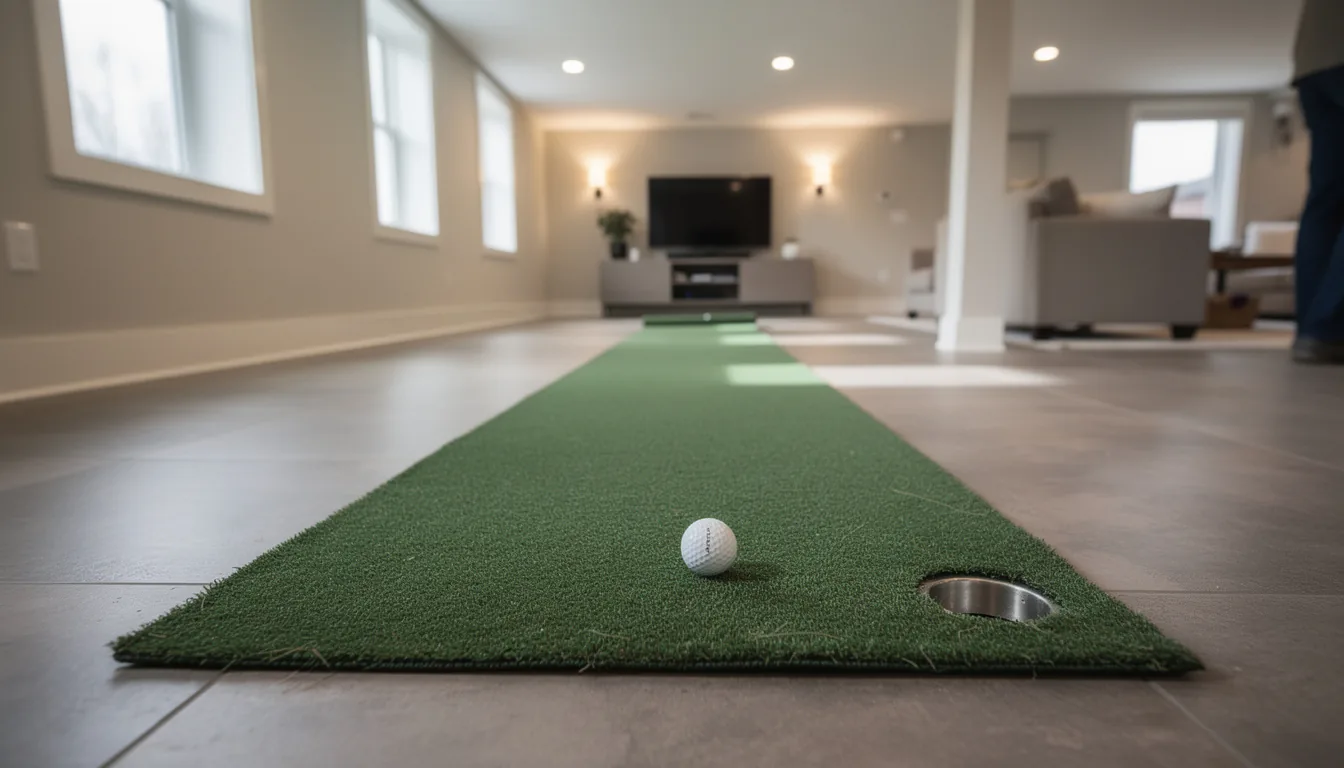
An indoor putting green is the one golf build that works in a room with a low ceiling, and the choice comes down to three formats: a roll-out mat for tight spaces, a modular green when you want real break, and a custom install when the room is permanent.
This guide is part of Putting Green Cost: What a Backyard or Indoor Green Really Runs.
Sections7
An indoor putting green is the one golf build that does not care about your ceiling. Putting needs no room above your head, so the basement, spare room or hallway that fails the height check for a full swing is still a perfectly good putting room. If your space came up short on the ceiling-height math, this is the build that still works.
The choice comes down to three formats. A roll-out mat for tight or shared rooms. A modular green when you want genuine break and movable holes. A custom install when the room is permanent and you want it to look like part of the house. What separates a green you use nightly from one that ends up rolled behind a sofa is not the format. It is whether the surface rolls the same way every time.
Mats, Modular Greens and Custom Installs
Three formats, three different jobs. Pick the one that matches your room and your patience, not the one with the most features.
Roll-out putting mats. A single piece of putting turf with a backing, usually with one or two cups or a ball return at the far end. They store rolled or folded and need a level supporting floor. The trade-off is a mostly fixed putting line. Compare the smaller-room putting shortlist first, before committing to a larger permanent green.
Modular greens. Interlocking base tiles or shaped panels with turf laid over the top. You can build contour into them, place several cups, change the layout, and extend the green later. This is the format that lets you practise a putt that actually moves. The cost is setup time and floor space, since a modular green wants to live somewhere permanently rather than roll away each night.
Custom installs. Turf laid on a shaped, levelled sub-base built into the room. Multiple cups, real contours, fringe around the edge, sometimes a chipping approach. It looks and rolls like part of the house because it is. The catch is that it is not moving again, and the room has to be worth committing.
The upgrade path is straightforward: start with a mat, and only build a modular or custom green once you know you putt indoors regularly. Plenty of people skip that step and end up with a permanent green they used twice.
Roll Speed, Stimp and Why Consistency Beats Fast
The number people ask about is speed. The thing that actually improves your putting is consistency.
Green speed is measured with a Stimpmeter, a simple ramp the USGA developed so the same ball rolls off at the same speed every time. The reading is just how far the ball travels in feet. Well-kept club greens sit in a moderate range, tournament setups run faster, and most quality indoor surfaces are built to land somewhere near that club-green feel.
Here is the part that matters more than the number:
- Consistency across the surface. The ball should roll the same near the cup as it does at the start. Low-grade turf with an uneven backing has fast lanes and slow patches, and your brain learns nothing from a surface that lies to it.
- Consistency over time. Fibres flatten where you stand and stand up where you do not. Brushing the nap back up keeps the roll honest.
- A speed that matches your home course. Practising on something dramatically faster than what you play trains a stroke that comes up short outdoors. Slightly slower is the safer error.
- Pile height and fibre. Short, dense, putting-specific turf rolls true. Deep-pile turf that looks lush is the wrong product for putting.
Ignore any surface sold on speed alone. A green that rolls true and repeats is worth far more to your stroke than a fast one that wanders.
Flat Putts, Breaking Putts and What Each Teaches
A flat surface and a contoured one train different skills, and most golfers only need one of them.
What a flat green teaches well. Face angle at impact, start line, and pace control. On a straight putt there is nowhere for a bad stroke to hide. If you miss, you missed. This is the single highest-value practice a golfer can do at home, and it is exactly what the short putts you keep leaving on the low side need.
What it cannot teach. Green reading. The break never changes, so after a week you know the line by memory rather than by reading it.
What contour adds. A modular or custom green with real slope forces you to pick a line and commit, and it makes pace and line interact the way they do on the course. Adjustable slope systems let you change the break between sessions, which keeps the read honest.
The honest middle ground. Most home golfers improve fastest by grooving the stroke on a true flat surface and doing their green reading on actual greens. Break at home is a nice extra, not the foundation.
One practical note on layout. A green with the cup dead centre at the far end gives you one putt. A green with cups at different distances and angles gives you a session. That is worth more than any speed rating.
Room Fit: The Build for Ceilings That Fail
This is the reason indoor putting greens exist. Every other golf build in the house is limited by height. This one is limited by floor.
A full swing needs real height above your head, which is what rules out so many basements. The space guide covers those limits in detail, and the ceiling-height rules are where most simulator plans die. Putting asks for none of it. If you can stand up in the room, you can putt in it.
What the room does need:
- Length. Around ten feet lets you work on the putts golfers miss most. Twelve to sixteen feet gives you room for lag work. Under eight feet you are only practising tap-ins.
- Width. Three to five feet is fine for straight putting. Six feet or more if you want to putt across a slope.
- A level floor. This is the one that catches people. A sloping basement slab or a floor that dips toward a drain will add break you did not choose, and it works against you on every putt. Check with a long level before you buy anything.
- A stable base underneath. Thick carpet lets the turf move and dulls the roll. A firm underlay or a hard floor gives a truer surface. The same logic as any golf build, and the gear breakdown covers what goes underneath.
- Somewhere the ball can stop. A backstop, a wall bumper or a ball return keeps you from chasing putts down the hallway all evening.
Rooms that already hold a simulator bay are ideal, since a putting strip often fits alongside the hitting area or rolls out in front of the screen between sessions.
What to Budget for an Indoor Putting Green
Prices move constantly across formats and sizes, so a number written here would be out of date before you read it. Two better places to work it out:
- Run your full build in the cost calculator, which prices a putting surface alongside the rest of a room rather than in isolation.
- Read the putting green cost guide for the per-square-foot logic. Outdoor and indoor pricing share the same drivers, which are turf grade, size, and whether somebody else builds the base.
The pattern is easy to hold in your head even without figures. Roll-out mats are the entry point by a wide margin. Modular systems sit in the middle and scale with area and contour. Custom installs are priced like small building work, because that is what they are. And in every format, turf grade and green size move the total more than anything else on the quote.
If a putting green is one line in a bigger project, the full cost guide shows where it sits against the launch monitor and enclosure, and breaks the whole build down room by room.
Setup, Base and Keeping the Roll Honest
An indoor green is simple to live with, but three things decide whether it still rolls true in two years.
Get the base flat first. Any dip under the turf becomes a permanent break. On a rough slab, a thin levelling underlay does more for the roll than upgrading the turf.
Let a new mat relax before judging it. Turf shipped rolled or folded holds creases, and a crease will kick a ball offline. Lay it flat, ideally somewhere warm, for a few days before you decide it is faulty.
Brush the nap. A stiff brush against the grain, every few weeks, stands the fibres back up. This is the whole maintenance routine for most indoor greens, and skipping it is why a surface slows down in the traffic areas and stays quick everywhere else.
Keep it out of direct sun. Long hours of strong light through a window will fade and stiffen synthetic fibres over the years.
Watch the seams on modular builds. Panels shift with temperature and foot traffic. A seam that has opened slightly is easy to close and horrible to putt across.
For anyone building a larger green into a room rather than buying one finished, a specialty indoor golf retailer stocking practice greens, putting surfaces, turf, and cup kits is the place to compare modular systems side by side.
The Verdict on Indoor Putting Greens
An indoor putting green is the highest-return golf purchase per square foot in the house, mostly because you will actually use it. Putting is the part of the game you can practise in socks at eleven at night, and it is the part that takes the most strokes off a score.
Choose by room, not by feature list. A roll-out mat for a shared or tight space, and it is where nearly everybody should start. A modular green when you want real break and movable cups and have the floor to leave it down. A custom install only when the room is permanent and the build is worth the commitment.
Then judge it on one thing: does it roll the same way every night? Consistency builds a stroke. Speed just impresses visitors. Check the floor is level before anything else, since a green built on a slope is training a compensation you will have to unlearn on real greens.
If the rest of the room can also hold a full swing, the space guide and the free Golf Simulator Build Planner will tell you what else fits alongside it. If it cannot, you have not lost anything. This is the build that works in the rooms the swing math rules out.
Quick answers
Do indoor putting greens actually improve your putting?
Yes, for stroke and start line. A consistent surface lets you groove a repeatable stroke and see immediately whether the ball starts on line. What it cannot teach is green reading, since the break is fixed. Treat it as stroke practice, not course simulation.
How much space does an indoor putting green need?
Length matters more than width. Around ten feet lets you practise the putts golfers miss most, and twelve to sixteen feet covers longer lag work. Width of three to five feet is enough for a straight green, more if you want to putt across a break.
What is the best surface speed for an indoor putting green?
Something close to a well-kept club green, and above all consistent from day to day. A surface that rolls the same every session builds a repeatable stroke. Very fast surfaces feel impressive at first and then teach a stroke that is too soft for real greens.
Can I put an indoor putting green in a room with a low ceiling?
Yes, and that is the main reason to build one. Putting needs no room above your head, so a basement or spare room that fails the height check for a full swing works perfectly for putting. Floor space and floor level are the only real limits.
Are modular putting greens better than a putting mat?
They are better at break and layout, not necessarily at roll. Modular systems let you build contours and move holes around. A good mat rolls just as true on a flat putt, sets up in seconds, and rolls away when guests come over.