Space & Room Size
Golf Simulator Ceiling Height: How Much You Need
As an Amazon Associate, this website earns from qualifying purchases.
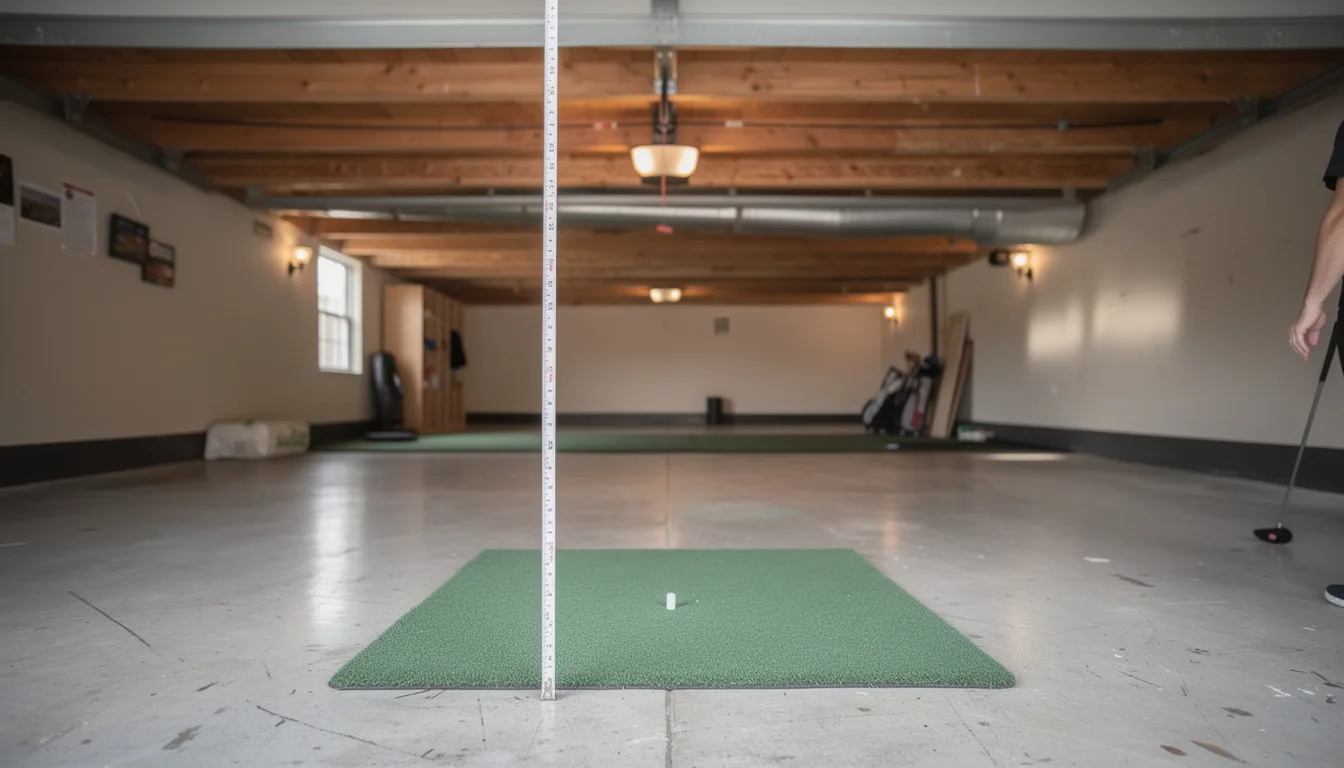
Nine feet is the working minimum golf simulator ceiling height for a full driver swing, 10ft is where you stop thinking about the ceiling at all, and under 8.5ft you are building an iron-and-wedge room.
This guide is part of Golf Simulator Room Size: The Real Numbers.
Sections8
- The Clearance Math: Your Height Plus the Arc
- Why 9ft Is the Floor and 10ft Is Comfortable
- Ceiling Height by Golfer Height
- What Actually Steals Your Clearance
- How to Test It With a Real Swing Before You Buy Anything
- Playing Under 8.5ft: What Still Works
- How to Buy Back Inches
- Verdict on Golf Simulator Ceiling Height
Golf simulator ceiling height is the one measurement you cannot fix later, and 9ft is the working floor for a full driver swing. Ten feet is where the room stops mattering and you just play. Under 8.5ft you are building an iron-and-wedge room, whether or not that was the plan. The number that counts is not the one on your floor plan: it is what is left after your mat lifts you up and a projector or overhead launch monitor drops down.
The Clearance Math: Your Height Plus the Arc
Start with a rough figure you can check in your own hallway. At the top of a full backswing, a typical golfer's clubhead sits roughly 3ft above the top of their own head. Add your height to that and you have a starting number. A 5ft 10in golfer lands near 8ft 10in before any margin at all.
Then add safety margin. You want 6 to 9 inches of clear air above the highest point the club reaches, because a swing is not a static measurement and your first sessions will not be your smoothest.
Shaft length moves the number more than most people expect. A standard driver runs 45 to 46 inches. Drop to a 44-inch shaft and the arc measurably lowers. Go the other way, to a 48-inch shaft, and you are asking for close to a foot more clearance. Long-drive shafts near 50 inches need more again.
One thing the math misses: most ceiling strikes happen on the follow-through, not the backswing. Steep wedge and short-iron swings finish high and fast, and plenty of golfers who clear the ceiling with a driver clip it with a gap wedge. Test both.
Why 9ft Is the Floor and 10ft Is Comfortable
Nine feet is where a full driver swing becomes physically possible for most golfers under about 5ft 10in. Workable is the honest word for it. You will still be aware of the ceiling, and you will still catch it occasionally on a steep backswing.
Ten feet is different in kind, not just in degree. At 10ft, golfers up to roughly 6ft 3in swing any club in the bag without the room entering their head. Trackman treats 10ft as the practical minimum for a comfortable swing rather than a nice-to-have.
The reason that gap matters is not really about contact. It is that awareness of a low ceiling alters the swing before the club ever touches anything. Golfers instinctively flatten and shorten, and that shows up in clubhead speed, attack angle and the loft you deliver at impact. You end up practising a swing you do not use on the course, and paying for precise data about it.
For a sense of how far the industry stretches: OptiShot publishes 8.5ft as its stated minimum clearance, which is about the lowest figure any major simulator brand puts in writing. Trackman sits at 10ft. That range tells you the honest answer is a band, not a single number.
Ceiling Height by Golfer Height
Your own height moves the threshold more than any other input, and the relationship is not tidy.
- Under 5ft 6in, flat swing. 8.5ft is workable for irons and short clubs. Nine feet gives you a full bag with real margin.
- 5ft 6in to 5ft 10in. Nine feet works for driver. Reports of clean driver swings at 8ft 9in exist, usually with a thin mat and a controlled tempo.
- 6ft to 6ft 2in. Nine feet gets tight with driver. It is a room you will be managing rather than enjoying. Ten feet is the sensible target.
- Over 6ft 2in. Treat 10ft as the minimum, not the goal. A 6ft 4in golfer in a 9ft garage clips the ceiling on driver swings consistently, and that is not a close call.
Swing plane matters alongside height. An upright or steep over-the-top move can want another 3 or 4 inches beyond these figures. A naturally flat swing buys some back.
What Actually Steals Your Clearance
Your drywall-to-floor measurement is not your usable clearance. Three things eat into it, and they stack.
The floor comes up. A hitting mat is 1 to 2 inches thick. Gym tiles, a vapour barrier or a plywood subfloor add another 1 to 2. Total penalty is 2 to 4 inches, which turns a 9ft room into an 8ft 8in one before anything is mounted. The flooring guide covers how thin you can safely build the stack.
The ceiling comes down. A ceiling-mounted projector takes 6 to 18 inches out of the swing zone depending on the mount. An overhead launch monitor takes a similar bite, and most overhead units need to hang 9ft or higher off the floor to track properly, so they are simply unavailable in an 8ft room. Floor-standing and beside-the-ball units avoid this entirely, which is a large part of why they dominate low-ceiling launch monitor choices.
Obstructions do not care about your ceiling. Ducts, beams, joists, soffits, light fixtures, sprinkler heads and garage door tracks all sit below the drywall. The lowest thing in your swing arc is your real ceiling height, full stop. A basement that reads 9ft 6in in the corner can be 8ft 10in where you actually stand.
How to Test It With a Real Swing Before You Buy Anything
This takes ten minutes and it is the single most useful thing you can do before spending money.
- Stand where the mat will go. Not the middle of the room, not the tallest spot. The exact hitting position.
- Raise yourself to mat height. Stand on a board or a stack of gym tiles the same thickness as the mat you plan to buy. Guessing this step is how people end up 2 inches short.
- Swing a driver at full speed. Not a rehearsal, not half tempo. The swing you will actually make when a course is on the screen.
- Mark the top of the arc. Have someone watch from the side and mark the ceiling above the highest point the clubhead reaches. Painter's tape works.
- Repeat with a wedge. Follow through fully. Mark that point too, because it is often higher than the driver mark.
- Measure to the higher mark and add 6 to 9 inches. If you have that, the room works. If you do not, you now know exactly how many inches you are short, which is what every fix below depends on.
Write the number down alongside your width and length. The free Golf Simulator Build Planner has the clearance worksheet and a ceiling-height decision tree so you are not re-measuring from memory in a showroom.
Playing Under 8.5ft: What Still Works
A low ceiling does not end the project. It changes what you are building, and the honest move is to decide that on purpose rather than discover it after delivery.
Shorter clubs. A 44-inch driver instead of 46 lowers the arc enough to matter, and you keep a club you can still use. Some builders go further and set the room up around a 3-wood and irons, treating the driver as a range club.
Punch swings and three-quarter tempo. This works, and it comes with a real cost. A swing you shorten to protect a ceiling is a swing you are grooving. If the sessions are about scoring practice and course play rather than swing changes, that trade is defensible. If you are trying to rebuild a swing, it is not.
Irons-only, on purpose. Below about 8.5ft, most adults are here whether they planned it or not. An iron-and-wedge room with good data is genuinely useful, and it is far better than a driver room with a dented ceiling. Camera-based units that sit beside the ball suit this build, and something like a photometric unit that sits alongside the mat keeps the overhead space clear.
Net instead of a screen. A hitting net and mat needs less room in every direction and costs a fraction of a full bay. The DIY cost breakdown prices this route honestly.
Putting and short game. If the ceiling is under 8ft and cannot move, stop fighting it. An indoor putting green needs no clearance whatsoever, and it will get used more than a room you are nervous to swing in.
How to Buy Back Inches
Ordered by cost, lowest first.
- Remove a drop ceiling. Recovers 6 to 12 inches for a few hundred dollars. The best return of any structural move, and the first thing to price in a basement. The basement build guide covers what you find behind the tiles.
- Thin the floor stack. A slimmer mat and no subfloor buys back 1 to 2 inches for nothing.
- Move the hitting spot. Ceilings are rarely level. Shift the mat to the tallest clear patch, or offset it to dodge a duct or a beam.
- Recess the mat. Sinking the hitting surface 1 to 2 inches into the floor buys clearance without touching the ceiling.
- Lower the floor. In a garage with a slab, digging down 4 to 8 inches and repouring is a real option, and a real expense. The garage build guide covers when that is worth pricing.
- Reroute the obstruction. Moving an HVAC duct or a light fixture out of the swing zone is often cheaper than people assume, and it is the fix that turns a "no" into a "yes" most often.
Before you commit to any of them, put your measured clearance into the Will It Fit? checker and cost calculator and see what the rest of the room supports.
Verdict on Golf Simulator Ceiling Height
Nine feet is the working minimum. Ten feet is the number that makes the room disappear. Under 8.5ft, build an iron room and enjoy it rather than building a driver room you flinch in.
Measure at the hitting position, to the lowest obstruction, then take 2 to 4 inches off for your flooring and another 6 to 18 for anything mounted overhead. Then go and swing a driver and a wedge in the room at full speed before a single item ships. Ceiling height is the only dimension in a simulator build with no cheap fix after the fact, so it is the one worth an afternoon of care. The full room size guide covers how it interacts with length and width, and the full cost breakdown shows what each tier actually buys.
Quick answers
What is the minimum ceiling height for a golf simulator?
Nine feet is the working minimum for a full driver swing, and that assumes you are under about 5ft 10in. Ten feet is the number where any golfer swings any club without thinking about it. Both figures mean clearance measured after your mat and any ceiling-mounted gear, not the raw number on the floor plan.
Can I build a golf simulator with an 8ft ceiling?
Yes, but not a full-bag one. At 8ft, most adults can hit wedges and short irons cleanly while the driver either clips the ceiling or forces a shortened swing. Golfers under about 5ft 6in with flat swings sometimes get more out of it. Plan the room around irons and accept that limit up front.
How do I know if my ceiling is high enough?
Take your driver into the room, stand on something as thick as your intended mat, and make a full-speed swing. Mark the highest point the clubhead reaches. You want 6 to 9 inches of clear air above that mark, and you should test a wedge too, because steep short-iron follow-throughs often reach higher than the driver.
Does the hitting mat count against my ceiling height?
It does, and people forget it constantly. A hitting mat adds 1 to 2 inches under your feet, and gym tiles or a plywood subfloor add 1 to 2 more. That 2 to 4 inch total comes straight off your usable clearance, which is enough to turn a 9ft room into an 8ft 8in one.
How much clearance does a ceiling-mounted projector take?
Between 6 and 18 inches, depending on the mount and the unit. That is the number that matters, not your drywall-to-floor measurement. An overhead launch monitor takes a similar bite and usually needs to sit 9ft or higher off the floor to work at all, which rules the category out of most 8ft rooms.