Cost Guide
Used Golf Simulator Cost: What to Buy, What to Skip
As an Amazon Associate, this website earns from qualifying purchases.
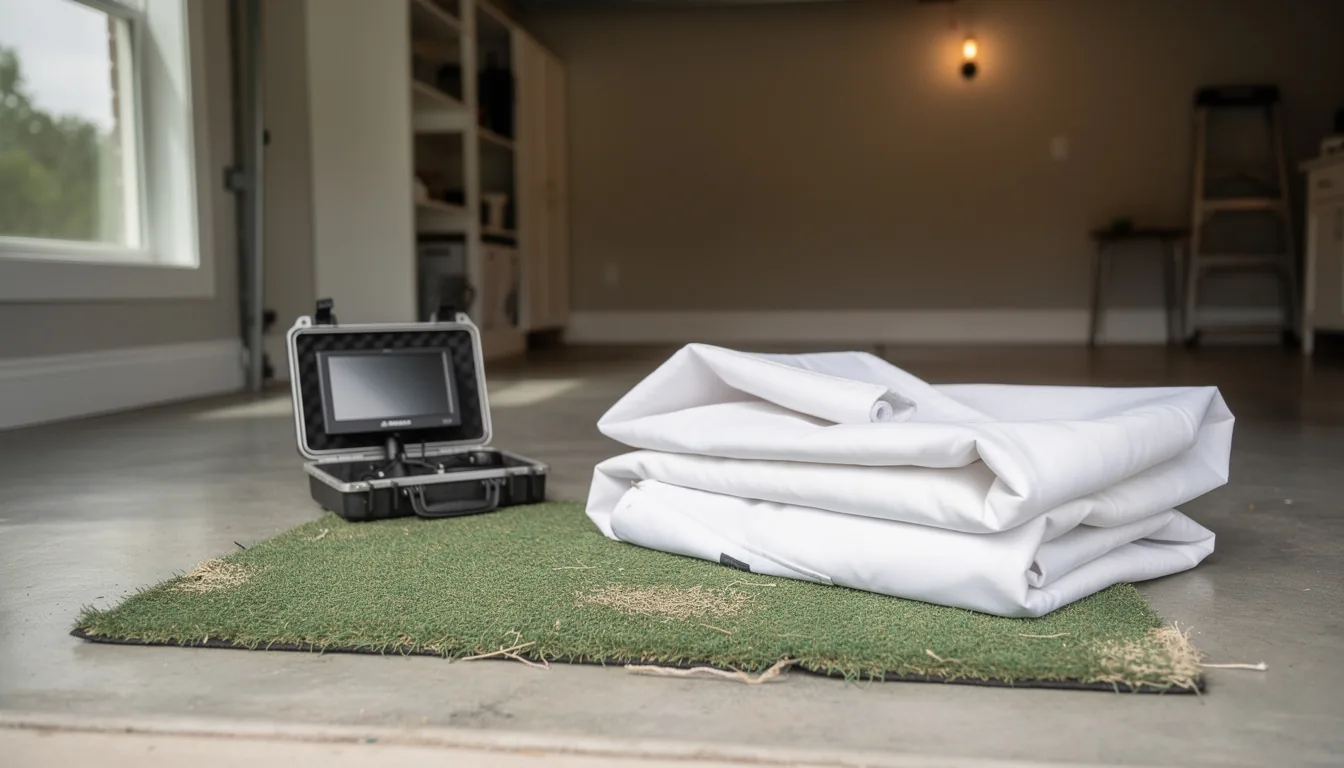
A used golf simulator runs 20 to 40 percent below the same gear new, so a $6,000 build lands nearer $3,800 to $4,800, with certified pre-owned launch monitors between roughly $1,300 and $12,000 depending on tier, and screens, mats and turf always worth buying new.
This guide is part of Golf Simulator Budget Breakdown: Parts, Room Prep and Five-Year Costs.
Sections8
A used golf simulator costs 20 to 40 percent less than the same gear new, and nearly all of that gap comes from one box. Launch monitors hold value the way good cameras do: slowly, and with years of life left in a three-year-old unit. Impact screens, mats and turf do the opposite. They wear out in the exact spot you keep hitting.
So the honest answer is not "buy used" or "buy new". It is buy the measuring gear used and the wear parts new. A build that prices at $6,000 new lands nearer $3,800 to $4,800 that way, and you give up very little. Run your own numbers in the cost calculator first, then use this page to work out which lines are safe secondhand.
What Holds Value in a Used Golf Simulator
For the launch-monitor category, use the under-$1,000 launch-monitor shortlist or the finished-bay shortlist. These are new-product affiliate roundups; verify transfer status, serial number and warranty directly when considering a used listing.
The rule is simple. If a part measures something or projects something, used works. If a ball hits it, used does not.
- Launch monitors. The best used buy in the whole build. A four-year-old camera unit measures ball speed and spin as it did new when it remains calibrated. This is also the most expensive line, so it is where the money actually moves.
- Projectors. Fine used, with one check. Lamp projectors have a rated bulb life and a replacement bulb costs real money, so ask for hours used. Laser units have no bulb to replace.
- Gaming PCs. A three-year-old machine that ran games well can still run simulator software, subject to its hardware and software requirements. The missing warranty is the main trade.
- Enclosure frames and cabinets. Check the frame for damage and missing fittings, then compare it with a new frame-and-screen kit. Price a replacement screen separately rather than treating worn fabric as an asset.
- Full commercial bays. Ex-facility units can carry large dollar gaps because the original retail was high and the resale pool is small. Compare the actual included equipment with these new simulator package options before paying for freight, rigging and installation. These packages are equipment comparisons, not commercial-installation quotes.
The launch monitor decision still comes down to your room before it comes down to price. Read the launch monitor buying rules first, because a radar unit bought secondhand for a 12-foot room is money wasted at any price.
What Never to Buy Used
Buy wear parts new: the impact-screen shortlist, hitting-mat shortlist, and flooring component shortlist cover current options. Screens, nets, and turf each have separate shortlists for replacement planning.
Four parts should always be new. Together they are a small share of the budget and the entire share of the risk.
- Impact screens. A screen absorbs repeated impacts at nearly the same spot. Fabric fatigues before it looks damaged from the front. Buy a replacement screen new.
- Hitting mats. Foam under the strike zone compresses and does not recover. A flattened mat passes more shock into the floor and golfer. Buy the hitting surface new.
- Nets. Netting degrades from repeated impact and light. A net that has taken years of driver work may be one ball away from a hole. Buy it new.
- Turf and underlay. These are low-cost wear surfaces, and used material can be dirty, compressed or expensive to move. Buy them new.
Buy those four new and the rest of the parts list is fair game secondhand.
What Used Golf Simulator Gear Actually Costs
These are typical asking ranges seen across retailer programs, marketplaces and classifieds. They are ranges, not quotes, and they move month to month.
- Entry radar units: $300 to $500 used. Garmin's Approach R10 and Rapsodo's MLM2PRO sit near $499 and $699 new, so the secondhand gap here is small in dollar terms. Often not worth the hassle.
- Mid camera units: $1,100 to $2,600 used. This is the busiest part of the market. SkyTrak units have listed near $1,595 through specialty retailers and near $1,100 in private forum sales, while a SkyTrak+ through a certified program has sat near $2,595 against roughly $3,000 new.
- Pro-grade photometric units: $4,500 to $12,500 used. Foresight's GC3 has run near $4,999 certified pre-owned against $6,999 new, and the GCQuad near $11,999 against $15,999 new. On a single box that is thousands of dollars, which is why this tier is where used genuinely pays.
- Projectors: $250 to $900 used. A 1080p short-throw that was $849 new is often half that at two years old.
- PCs: $400 to $900 used.
- Enclosures and cabinets: $800 to $2,000 used, against $3,099 to $3,999 for the common pre-built widths new. Assume you are buying the frame only and adding a new screen.
- Complete home builds: $2,500 to $9,000 used for setups that cost $5,000 to $14,000 new.
- Ex-commercial bays: $8,000 to $25,000 used. Lightly used units from the big cabinet makers have carried original retail near $58,900, which is where the largest gaps in the whole market sit.
Compare any of those against the new-build tiers in the full cost guide before you commit, because a used mid unit and a new entry unit sometimes land at the same number. For a current new-price ceiling, compare new launch monitors at Indoor Golf Shop and price a new enclosure or screen separately; do not treat a used package's worn screen or mat as part of its value.
Where People Actually Buy Used
Four places, in rough order of price and protection. You are choosing how much warranty you want to pay for.
Certified pre-owned at specialty golf retailers. The safest route and the most expensive used route. Units are inspected, graded, and sold with a return window and some warranty coverage. This matters more on a $5,000 photometric unit than on a $400 radar. Price certified pre-owned units from specialist retailers before you look anywhere else, because those numbers set the ceiling for everything below.
Dedicated used-simulator marketplaces. Sites built specifically to list secondhand bays, screens, mats and monitors. Better selection than general marketplaces, and sellers who know what they own. Protection varies by listing.
Simulator forums and GolfWRX classifieds. The cheapest listings on the internet, and the ones with the least recourse. Enthusiast sellers usually describe gear accurately, but there are no returns and no grading. This is where the largest gaps against new turn up, and also where the fakes do.
eBay and local marketplaces. Fine for projectors, PCs and frames. Riskier for launch monitors, where a serial number can be reported stolen or already registered to somebody else. Pay by a method that carries buyer protection and never by bank transfer. The FTC publishes plain guidance on how marketplace scams are structured and which payment methods leave you with no way back.
Commercial resellers and asset auctions. Where ex-facility bays surface when a venue closes. Big gear, big freight bills, and often a rigging cost you have to arrange yourself.
The Used Launch Monitor Inspection Checklist
Run this before money moves. It takes ten minutes and catches nearly everything that goes wrong.
- Get the serial number in advance. Ask the maker whether it is registered, whether warranty remains, and whether warranty transfers to you. Garmin, Foresight and the rest all answer this, and you can start from Garmin for their own units.
- Confirm what the subscription does on transfer. Some platforms tie the course library or data plan to the original buyer. A cheap unit plus a fresh annual plan is not always cheap.
- Ask for a video of it working. Powered on, paired to the app, five real shots with numbers on screen. Refusal to do this is the single clearest warning sign in the market.
- Check the lens and sensor windows. Scratches or hazing on camera units change readings. Look for cleaning marks, not just cracks.
- Check the case and mounts. Dents mean it has been dropped, and a dropped photometric unit can be quietly out of calibration.
- Confirm the original box, cables and charger are included. Proprietary chargers cost real money to replace.
- Ask what it is being sold with. Some listings quietly exclude the tripod, case or club markers that shipped new.
- Ask why they are selling. Upgrading is normal. Vague answers about a unit that "needs a service" are not.
For a build you are still measuring rather than buying, the ceiling-height math rules out more used purchases than any inspection ever will.
How Far Below New Used Actually Lands
The honest average across the market is smaller than people expect. Golfer Logic's survey of used simulator listings put the average at just under 31 percent below new, with individual finds reaching 45 percent on forum sales and closer to 20 percent through retailer programs.
Compare that with used golf clubs, where the average is higher and the risk is nearly zero. A club cannot fail in a way that costs you $2,000. A launch monitor can.
That is the real calculation. A 20 percent gap on a $2,000 unit is $400, which is not much cover for having no warranty and no returns. A 30 percent gap on a $16,000 unit is $4,800, which absolutely is. Used pays hardest at the top of the market and barely at all at the bottom.
When Buying New Still Wins
Five situations where the used market is the wrong answer.
- Entry tier. The dollar gap on a $499 unit is too small to be worth losing warranty coverage.
- You need it to work on day one. New gear that fails gets replaced. Used gear that fails becomes a project.
- The subscription does not transfer. A used unit plus a full-price plan can cost more than a new bundle.
- You are buying wear parts anyway. If the used package includes a tired screen and mat, subtract their full new price from the asking number before you compare.
- You want one supplier when something breaks. Mixed used gear means each maker points at the other.
If a used build is not coming together at a number you like, the main cost guide prices the new equivalent by room type, and the DIY cost breakdown shows where your own labour moves similar money.
The Verdict on Used Golf Simulator Cost
A used golf simulator saves 20 to 40 percent against the same gear new, and that gap is concentrated almost entirely in the launch monitor. Buy that used, buy the projector and PC used if the price is right, and buy the screen, the mat, the net and the turf new every single time.
Weight the risk by the dollar gap. Under about $1,000 of gap, take the new warranty. Over about $3,000, a certified pre-owned unit from a specialty retailer is one of the best-value purchases in home golf. Between the two, it depends on whether you have the patience to inspect properly.
Measure the room before you shop either market. The space guide covers what your house can actually hold, and the free Golf Simulator Build Planner has the measuring worksheet and the budget tiers on one page. Extras like an indoor putting green can wait until the bay is working.
One last note that costs nothing: get the serial number, ask the maker about warranty transfer, and ask for a video of the unit hitting real numbers. Sellers who mind those three questions are telling you something useful.
Quick answers
How much does a used golf simulator cost?
Expect 20 to 40 percent below new for the same gear. A build that prices at $6,000 new comes together for roughly $3,800 to $4,800 secondhand. Certified pre-owned launch monitors run about $1,300 to $12,000 depending on tier, and private-sale units sit lower with no warranty.
Is it worth buying a used golf simulator?
Yes for the launch monitor, projector and PC. No for the impact screen, mat and turf, which wear out exactly where the ball lands. Buying the measuring gear used and the wear parts new gets you most of the price gap with almost none of the risk.
What should I never buy used for a golf simulator?
Impact screens, hitting mats, nets and turf. All four are consumables. A screen that looks fine hanging up can be stretched thin at the strike point, and a worn mat passes shock straight into your wrists. These parts cost the least new and fail the fastest used.
Where do people actually buy used golf simulators?
Certified pre-owned programs at specialty golf retailers, dedicated used-simulator marketplaces, simulator forums and GolfWRX classifieds, eBay, and commercial resellers handling ex-facility bays. Retailer programs cost more and carry a warranty. Forums are cheapest and carry none.
Do used launch monitors still get software updates?
Usually yes, but the subscription is the thing to check. Some platforms tie a course library or data plan to the original buyer, so a transferred unit needs a fresh plan. Confirm transfer rules with the maker before you agree a price, not after.