Components
Golf Simulator Net: Safe Indoor Practice Guide
As an Amazon Associate, this website earns from qualifying purchases.
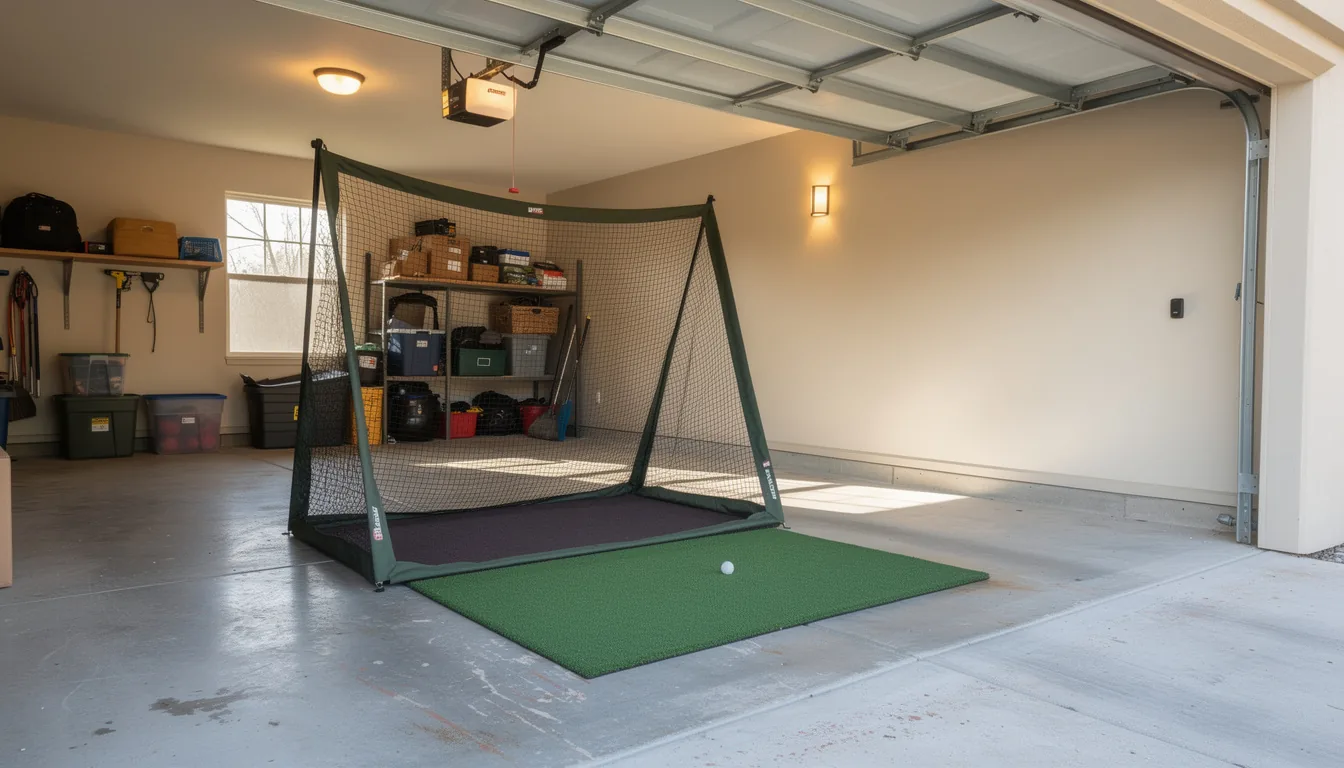
A golf simulator net is the right build when your room is short on height or length, since it needs less clearance than a screen and enclosure while still catching full driver swings, so long as you add side barriers and stand well back.
This guide is part of Golf Simulator Components: The Full Parts List.
Sections8
A golf simulator net stops the ball and nothing else. It carries no projected image, so you read your shot numbers off a tablet or a TV. That trade buys you something a screen build cannot: a setup that fits in a room too short or too low for a full enclosure.
Net builds get dismissed as the beginner option. They are not. A net is the correct answer for a garage that still parks a car, a spare room with an 8-foot ceiling, and anyone who wants to hit balls this month rather than plan a room for six.
This page covers when a net beats an enclosure, what actually stops a golf ball, how side barriers work, and the safety margins the makers publish.
Net-Only Build vs Full Enclosure
The two builds differ in what they demand from your room, not just what they show you.
A screen build needs a frame, an impact screen, an enclosure surround, a short-throw projector, and clearance behind the screen for the ball's energy to go somewhere. That stack wants height above all else. A net needs a frame, netting, and floor space.
Here is the honest split:
- Choose a net if your ceiling is under about 9 feet, your room doubles as something else, you want it up this weekend, or you mostly practise rather than play rounds.
- Choose a screen and enclosure if you want the projected course image, you have the height, and the room is dedicated to golf.
What you give up with a net is immersion. You get numbers, not a fairway. What you keep is every bit of the ball and club data, because the launch monitor does not care what the ball flies into. The full picture of how the parts fit together is on the components overview.
Net builds also upgrade cleanly. Several bay-style nets accept an impact screen later, so the frame you buy now is not wasted if you add a projector down the line.
What Actually Stops a Golf Ball
Stopping power comes from three things working together: the netting material, how tightly it is knitted, and how the net is hung.
Material is usually polyester or nylon. Both are strong enough when the mesh is tight. A loose, open mesh is what lets a ball find its way through, so tight-knit construction matters more than the fibre name on the label.
Slack does the real work. A net hung with give absorbs the ball by slowing it down over a distance. A net stretched drum-tight has nowhere to move, so the ball rebounds hard back toward you. This is why proper simulator nets hang with deliberate slack and why makers pad the frame tubing.
The frame decides how long the netting lasts. Rigid frames that hold shape keep the ball hitting netting rather than metal. Frame padding, standard on most simulator bay nets, is there to catch shots that clip the tubing instead.
Netting is a wear part, so compare its warranty and replacement options separately from the frame. When you know your room width, compare the practice-net shortlist against the frame sizes below.
Net Sizes and What They Cover
Net sizing is about catching mishits, not catching your good shots. Your good shots go straight into the middle.
Common sizes from The Net Return give a useful ladder:
- Home size, around 7 feet square: fine for irons and wedges in a tight room. Snug for a driver.
- Pro size, around 8 feet wide by 7 feet 6 inches tall: the usual home full-swing size.
- Pro Series, 8 to 10 feet wide by 8 feet tall: the size most people settle on for confident driver use.
- Extra-large, around 10 feet wide by 9 feet 5 inches tall: for rooms with the height to spare, and for two-handed households.
- Mini, around 5 by 6 feet: chipping and wedge practice only.
Frame footprint matters too. Net Return bay frames run about 3 feet 6 inches front to back, so the net occupies real floor space, not just wall space. Their simulator bay frame stands 8 feet 10 inches at the rear bar, rising to about 9 feet once a projector mount is fitted, which is a reminder that a bay net is not automatically a low-ceiling solution.
Weight tells you how portable a net really is. Pop-up style nets run in the 20-to-30-pound range, while a full simulator bay frame is closer to 65 pounds. One you move weekly. The other you build once. Check both against the room size guide and the ceiling height page before ordering.
Side Barriers and Overhead Netting
A flat net panel catches the shots you hit straight. Side barriers catch everything else, and everything else is the reason nets exist.
A thin toe strike leaves at an angle a rear net never sees. Indoors, that shot finds drywall, a window, or a car. Side barriers extend the catching area out past the frame edges so those shots are contained. SimSpace, for example, ships 3 metres of side netting with its practice net for exactly this.
Overhead protection is the other half. A skied shot off the top of the clubface climbs steeply and can clear the top of the frame entirely. Net Return sells an overhead protector for this, and DIY builders solve it with ceiling netting. Rogue Engineer ran blackout curtains and netting on EMT pipe above his bay to catch stray shots, as documented in his home build write-up.
Treat both as part of the net, not accessories. A bare net panel in a finished room is how people put a ball through plasterboard in week one. The same logic drives full enclosures, covered on the enclosure page.
Safety Margins: How Far Back to Stand
Ricochet risk goes up the closer you stand, and it is the frame, not the netting, that sends a ball back at you.
Makers publish buffers, and they are minimums. SimSpace asks for roughly 50cm of clear space behind the net and 20cm on either side so impacts have somewhere to go. Leave that space clear of walls, boxes, and anything the frame can be pushed into.
Your standing position matters just as much:
- Stand back far enough that a rebound loses its energy before it reaches you. Full enclosure makers recommend 10 to 12 feet from the screen, and the same thinking applies to a net.
- Keep the frame padded. Foam on the tubing turns a hard ricochet into a dead drop.
- Clear the floor between you and the net. Balls come back along the ground more often than through the air.
Room length is the constraint people miss. The Net Return notes that the front-to-back space needed varies by launch monitor, from about 14 to 22 feet, because radar units need clear room behind the ball. That number often decides the whole build. For tight garages, the garage build guide covers the workarounds, and the cost guide helps with planning the spend.
Indoor vs Outdoor Golf Simulator Nets
Netting ages fastest in sunlight. Ultraviolet light breaks down fibres, so a net left outdoors year-round has a much shorter lifespan than the same net used inside.
Outdoor use wants a weather-resistant frame that will not rust and netting treated for UV. Check the model is rated for it rather than assuming. Wind is the other factor: a light frame in an exposed garden needs anchoring or it walks.
Indoor use is easier on the net but harder on the room. You need the side and overhead protection covered above, and you need to think about noise, since ball strike and net snap carry through a house far more than owners expect.
A useful middle path is a portable net used outside in good weather and stored inside, which sidesteps UV ageing entirely. That works with the lighter pop-up frames, not with a bolted bay.
When a Golf Simulator Net Is the Right First Step
Buy the net first when the room is the limit and you want to be hitting balls now.
A net plus a launch monitor plus a decent mat is a complete practice setup. You get every number the launch monitor produces. You lose the course image, which matters for playing rounds and matters much less for grooving a swing.
The upgrade path is friendly. Add an impact screen and a projector to a bay-style frame later, or move the net outdoors and build a proper bay indoors. Nothing you buy now becomes useless.
When you are ready to add a projected image, compare impact screens at Indoor Golf Shop against your frame dimensions. Use the DIY route if you are building the frame yourself, and the free Golf Simulator Build Planner to record the measurements.
Golf Simulator Net Verdict
A golf simulator net is a real build, not a compromise, in any room that cannot give a screen and enclosure the height they need. Buy the tight-knit netting, take the side barriers seriously, pad the frame, and stand further back than feels necessary.
Match the net size to your worst strike rather than your best one, and check the front-to-back space your launch monitor demands before anything else. Get those two right and a net will take a quarter of a million shots before you think about it again.
Quick answers
Can you use a golf simulator with just a net?
Yes. A launch monitor, a hitting mat, and a net make a working practice setup. You read your numbers on a tablet or a side-mounted TV instead of a projected course image. Net builds suit rooms that cannot take the height or length a screen and enclosure need.
Are golf simulator nets strong enough for a driver?
Purpose-built simulator nets are, when used as designed. Look for tight-knit polyester or nylon, a frame rated for full swings, and padding on the frame tubing. The Net Return warrants its nets to 250,000 shots or three years, whichever comes first, which tells you the sort of use they expect.
How far should you stand from a golf simulator net?
Follow the maker's stated distance and treat it as a minimum, not a target. SimSpace asks for a buffer of roughly 50cm behind the net and 20cm at each side for ball impacts. Standing closer raises the chance of a ricochet coming back at you off the frame.
Do I need side netting with a golf simulator net?
For full swings indoors, yes. Toe and heel strikes leave at angles a flat net panel never catches, and side barriers are what stop those finding a wall or a window. Most simulator bay nets include side barriers because the maker expects mishits.
Can a golf simulator net be used outdoors?
Some are built for it with weather-resistant frames and UV-treated netting, and others are strictly indoor. Sun and rain age netting far faster than indoor use does, so check that the model is rated for outside before leaving it up. Taking an indoor net down between sessions extends its lifespan a lot.