Components
Golf Simulator Enclosure: Kits, DIY Frames, Sizing
As an Amazon Associate, this website earns from qualifying purchases.
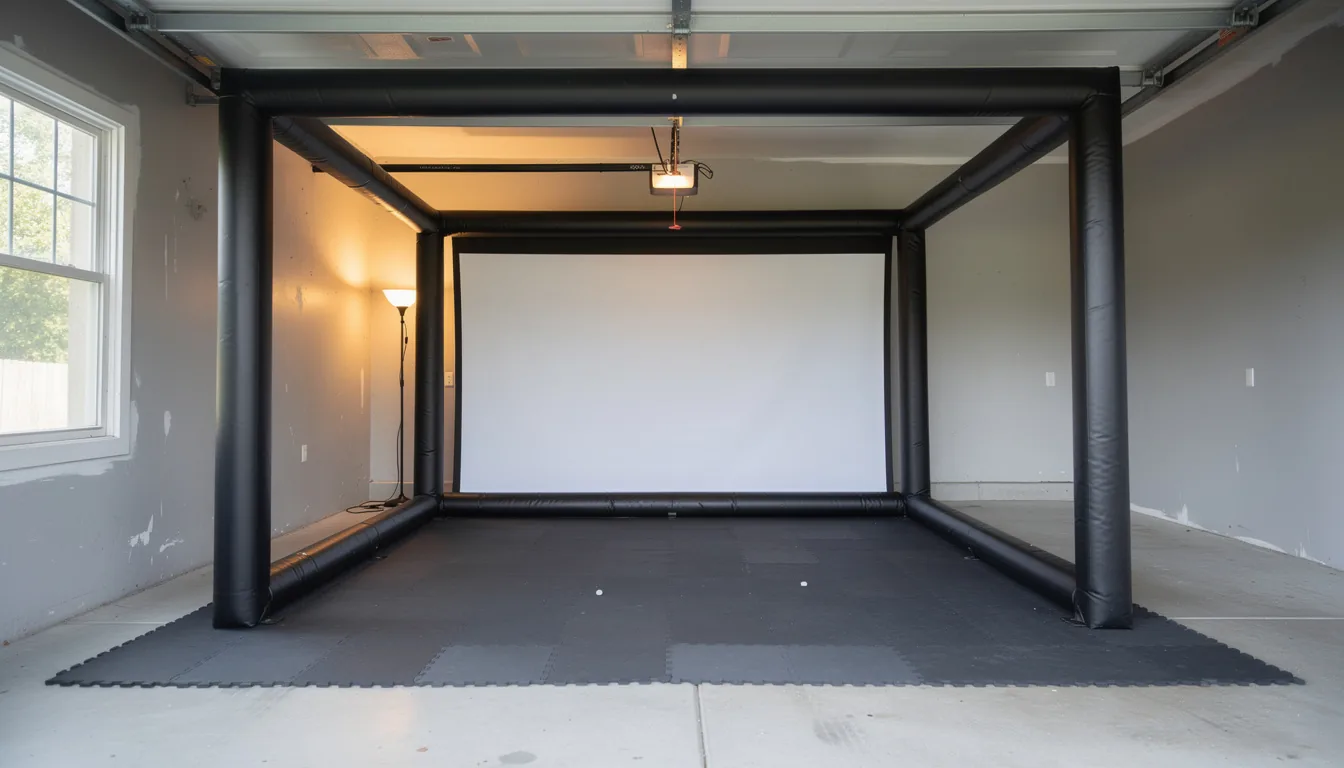
A golf simulator enclosure is a frame plus a light-blocking fabric surround that holds the impact screen flat, catches mishits, and darkens the room, and it must be sized about six inches under your ceiling height rather than to it.
This guide is part of Golf Simulator Components: The Full Parts List.
Sections8
A golf simulator enclosure is a frame plus a fabric surround. The frame holds the impact screen flat and square. The fabric catches the shots that miss the screen and soaks up room light so the projected image keeps its contrast. That is the whole job.
It is also the part of a build most likely to be sized wrong, because people measure their ceiling and order an enclosure the same height. That leaves no room to assemble it, and no room for the mat and flooring that lift the ball.
This page covers kits against DIY frames, how to size one honestly, what the blackout fabric is doing, and the difference between ceiling-hung and floor-standing builds.
What a Golf Simulator Enclosure Actually Does
Three jobs, in order of how much they matter.
- Holds the screen flat. A screen needs even tension across its whole face to project a clean image. The frame is what delivers that, and a flimsy frame shows up as ripples in the picture.
- Contains mishits. A thin strike leaves the clubface at an angle no flat screen ever covers. The side and ceiling panels are what stop those finding drywall.
- Kills ambient light. Light bouncing off pale walls washes out a projected image. Dark fabric around the screen absorbs it instead.
The third one surprises people. Owners buy a brighter projector to fix a washed-out picture when the actual problem is a white wall reflecting light straight back at the screen. Fabric is the cheaper fix. The impact screen page covers the screen side of that same problem.
Enclosure Kits vs DIY Frames
Both routes end up in the same place. They differ in how much of the thinking you outsource.
Kit enclosures arrive as a matched set: frame, fittings, fabric surround, screen, bungees, foam padding, and instructions. SimSpace ships modular poles with Velcro panels and bungee toggles. Elite Sim Golf builds on powder-coated steel. Carl's Place and Shop Indoor Golf sell pipe-based kits sized to order. The appeal is that every part is already known to fit every other part.
DIY frames are usually EMT conduit, the electrical tubing sold in any hardware store, joined with corner fittings. No welding, no specialist tools. Rogue Engineer's documented build used EMT pipe for both the frame and ceiling-mounted curtain rails, with side curtains and overhead netting catching stray shots.
There is a useful middle option people miss. Shop Indoor Golf sells a custom DIY kit where they supply the fittings, bungees, and hardware and you supply the pipe. You get the engineering without paying to ship heavy tubing across the country.
Pick a kit if you want it right the first time and assembled this weekend. Pick DIY if your room is an awkward shape, or if you want a size no kit offers. The DIY cost breakdown covers what the self-build route involves, and the kit page covers the packaged alternative.
Sizing a Golf Simulator Enclosure to Your Room
This is where the money gets wasted, so it is worth being precise.
The rule that matters most comes from Carl's Place: your room should be at least 6 inches taller than the enclosure height you choose. A 9-foot enclosure needs a 9-foot 6-inch room. That headroom is not luxury, it is the space needed to physically assemble the frame and stand it up.
Then subtract what you add to the floor. A hitting mat lifts the ball about 2 inches, and turf or a subfloor adds more. Every one of those inches comes off your swing clearance. Measure your ceiling from the finished floor, not the bare slab, which is why the flooring guide and this page have to be read together.
Width and front-to-back space follow their own rules:
- Side clearance: Carl's Place asks for 2 to 3 inches between the frame and each side wall for tensioning and airflow.
- Behind the screen: allow 12 to 16 inches so the screen can move back on impact.
- Total footprint: Elite Sim Golf's commercial bay runs 6 feet front to back, made up of 5 feet of playable space plus a built-in 1-foot stand-off that keeps the frame off the wall behind.
Typical home sizes cluster around 10 to 13 feet wide. Elite Sim Golf's Eagle 12 measures 12 feet wide by 8 feet 2 inches tall by 5 feet front to back, which is a fair picture of what a mainstream home bay occupies. Check those figures against the room size guide and the ceiling height page before ordering, and use the build planner for the budget side.
Blackout Fabric and Ambient Light
The fabric is not decoration. It is optical equipment.
Carl's Place uses a heavy-knit polyester it calls BlackStop, chosen to absorb ambient light and lift contrast on the screen. Elite Sim Golf and SimSpace line their interiors with velvet or black velour for the same reason. Velvet is used because its pile traps light rather than reflecting it, the same trick a cinema uses on its walls.
Light gets in from two directions, and each has its own fix:
- Front light from windows, lamps, or a garage door hits the screen directly. The surround cannot stop this. Blinds, a grey screen, or a brighter projector are the answers here.
- Spill light bounces off the walls and ceiling around the screen. This is what the fabric surround kills, and it is usually the larger of the two problems.
Rear light bleed is the third case. Elite Sim Golf offers a rear blackout panel behind the screen, which stops light from a window or door behind the bay glowing through the fabric. A screen is not opaque, and light behind it shows up as a grey haze on the image.
If the room cannot be darkened at all, pair the enclosure with a grey screen rather than fighting it with lumens. Garage bays in particular face this constantly, and the garage build guide covers the specifics.
Ceiling-Mounted vs Floor-Standing Frames
Two ways to hold the structure up, and the choice usually comes down to whether the room is yours to drill.
Floor-standing frames are self-supporting. They carry their own weight through the frame feet and need no fixings in the building. Carl's Place Pro enclosures weigh 180 to 260 pounds with fittings and fabric, and pipe kits add another 40 to 80 pounds, so they stay where you put them. SkyTrak adds weighted bottom bag attachments to hold the base steady. This is the route for renters and for anyone with unknown ceiling structure.
Ceiling-mounted builds hang the frame or the surround from joists above. They free up floor space, remove the front vertical posts from your eyeline, and let curtains run on ceiling tracks. Rogue Engineer ran 1-inch EMT pipe from the back wall into the ceiling to carry his blackout curtains. The catch is that you must hit real structure, not just plasterboard, and you need to know what the joists will carry.
A hybrid is common and sensible: a floor-standing frame for the screen, with side curtains and overhead netting hung from the ceiling. That combination puts the heavy load on the floor and the light, wide coverage overhead where it belongs. When you know the size and mount style you want, compare golf simulator enclosures and frame kits at Indoor Golf Shop.
Safety Padding and What Goes Wrong
The screen is soft. The frame is not, and the frame is what hurts people.
Every quality kit ships padding for exactly this reason. SkyTrak includes custom-fit foam frame guards. Carl's Place supplies foam inserts that slide between the frame and the fabric to absorb vibration, dampen sound, and cut rebound off the tubing. Elite Sim Golf runs anti-collision padding along the top rail of its Albatross frame.
Fit all of it. SkyTrak is blunt on this point, telling owners they must attach the Velcro border protection around the whole edge of the screen before use. A ball that catches bare steel comes back fast and unpredictably.
Distance is the other half of safety. Elite Sim Golf recommends standing 10 to 12 feet from the screen, and notes that even a 62-degree wedge struck from about 10 feet away should not have the launch angle to reach the top of the enclosure. Stand closer and that stops being true.
Two more habits worth building:
- Set the frame once. Dragging enclosure feet across turf tears the fibres and knocks the frame out of square.
- Re-tension after the first week. Fabric and bungees settle, and a screen that has gone slightly slack ripples on camera before you notice it by eye.
If your room cannot safely take a full bay, a net build is the honest alternative, covered on the net page. To pair the screen with the frame you choose, browse golf simulator impact screens at Indoor Golf Shop.
Assembly, Weight and Permanence
Assembly times tell you how permanent each design really is.
SimSpace quotes 20 to 30 minutes with two adults using its click-together poles and Velcro panels. GolfBays puts its SimBox at around 45 minutes and says it folds down for storage. Elite Sim Golf lists 45 to 60 minutes for the Eagle 12 and 60 to 90 minutes for the wider Albatross 13S. Its commercial 2-inch EMT frame assembles with corner connectors and a numbered diagram, no welding required.
Weight is the honest signal of permanence. A folding bay you can move alone is a different object from a 260-pound steel frame that becomes part of the room. Decide which one you are buying before you order, because both are sold with similar photographs.
Two people, two hours, and a clear floor covers almost every home build. For the full parts list and buying order, the components overview is the place to start, and the cost guide handles planning the spend.
Golf Simulator Enclosure Verdict
A golf simulator enclosure is a frame, a fabric light trap, and a safety cage sold as one product. Size it six inches under your ceiling, not level with it, and subtract the mat and flooring height before you order.
Kits are worth it for the certainty that the parts fit each other. DIY earns its place in odd-shaped rooms and unusual sizes. Either way, fit every piece of foam that comes in the box and stand ten to twelve feet back, and the enclosure will be the part of the build you stop thinking about.
Quick answers
Do I need an enclosure for a golf simulator?
Not always. A screen and frame alone work in a finished room with dark walls and no side hazards. The fabric surround earns its place when mishits could reach a wall, a window, or a car, and when room light is washing out the projected image.
What size golf simulator enclosure fits my room?
Carl's Place advises that your ceiling should be at least six inches taller than the enclosure you pick, so a nine-foot enclosure wants a room of nine feet six inches. Allow two to three inches at each side wall for tensioning and airflow, plus clearance behind the screen.
Can you build a golf simulator enclosure yourself?
Yes, and it is one of the most common DIY routes. Most home builds use EMT conduit with corner fittings, which needs no welding. Kit makers also sell frame-only fitting sets so you buy the connectors and bungees and source the pipe locally to save on shipping.
What is the black fabric on a golf simulator enclosure for?
It absorbs stray light rather than bouncing it around, which lifts contrast on the projected image. Carl's Place uses a heavy-knit polyester it calls BlackStop, and several makers line the inside with velvet or velour. The same fabric also catches shots that miss the screen.
How far should you stand from a golf simulator enclosure?
Elite Sim Golf recommends standing roughly ten to twelve feet from the screen. At that distance a lofted wedge will not reach the top rail, and rebounds lose energy before they get back to you. Standing close is the single most common safety mistake in home bays.